The life cycle of health technologies: from investment to disinvestment


Health systems have considered the introduction and withdrawal or elimination of health technologies a linear process in which different actors interact (innovators, industry, regulators, health technology evaluators, reimbursement agencies, health service providers, health professionals, patients and citizens). The lack of interchange of knowledge between phases and the little interest in what happened once the technology has been introduced has generated that this linear process is inefficient. Among the causes of inefficiency someone can find: the lack of knowledge of innovators around health needs, the introduction of health technologies of dubious value, the generation of unjustified variability in practice or the maintenance of no added-value practices.
The cyclical concept of the technology life cycle provides a dynamic and context-dependent perspective, referring to the different stages that a health technology goes through from the introduction of innovation to its obsolescence, displacement by competitors, or demonstration of low utility, providing at each stage the precise, high-quality information needed for decision-making by all stakeholders. Each phase has specific characteristics that determine the type of evidence available, and the type of evaluation required.
Life cycle phases
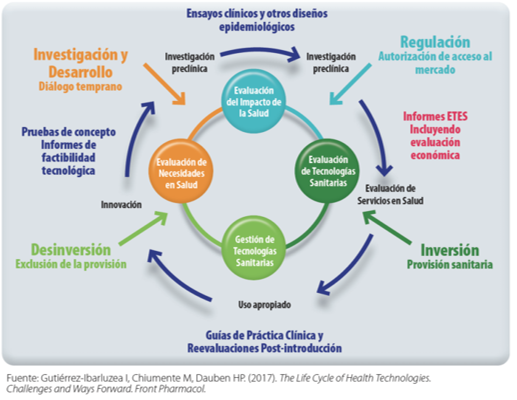
- Research and development (R&D)
Initial design of the technology and generation of preclinical and early clinical evidence.
- Early identification and assessment (early awareness)
Detection of new and emerging health technologies (NEHTs), with high uncertainty and limited evidence.
- Assessment for adoption
More in-depth analysis of a health technology’s efficacy, effectiveness, efficiency, and safety, as well as the organizational, social, ethical, and legal implications of its implementation.
- Adoption and implementation
Introduction into clinical practice and definition of conditions for use.
- Diffusion and widespread use
Expansion of the technology, with real-world evidence generation (effectiveness, safety, economic impact).
- Reassessment
Ongoing review of technology´s value as new evidence emerges or alternatives arise.
- Disinvestment / withdrawal
Systematic reduction or removal of technologies that are obsolete, ineffective, or offer limited value.
Since its establishment in 1992, the Department of Health, specifically through Osteba, has been working to improve the adoption and use of health technologies. Since 2007, it has also focused on the disinvestment of technologies with doubtful or no clinical value.
This work has led to the development of the SorTek and ZaharTek programmes, collaboration in methodological projects (GANT, GEN, GiNF, and GuNFT guidelines), participation in networks such as RedETS and iHTS, as well as involvement in national FIS-funded projects (https://cienciadedatosysalud.org/atlas/desinversion-2017/ ), European initiatives (Zinnige Zorg), and international collaborations, including the HTAi Disinvestment and Early Awareness Interest Group (https://htai.org/interest-group/disinvestment-and-early-awareness/). Osteba also collaborates with the MAPAC group on the appropriateness of clinical practice within the framework of two FIS-funded projects.
As a result of these experiences and initiatives, several outputs have been developed, including lists of new and emerging health technologies, assessment briefs on these technologies, Clinical Practice Guidelines (specific section), and assessment briefs on obsolete or low-value health technologies.
The following section presents the methodological advances and ongoing initiatives in these areas in which Osteba has participated. Together, these activities form part of what may be described as the “Choosing Wisely” movement or the “Right Care” approach within the Basque Health System.
Support material
- A toolkit for the identification and assessment of new and emerging health technologies (PDF, 1 MB)
- La identificación de tecnologías sanitarias emergentes (PDF)
- RedETS
- iHTS
- Utilización de procedimientos de dudoso valor
- Estudio piloto de identificación y evaluación de tecnologías sanitarias obsoletas a partir de las bases de datos de tecnologías emergentes.
- Metodología del Atlas Utilización de Procedimientos de dudoso valor (PDF, 341 KB)
Last modified date: