|
|
1998
| Euskadi prize for literature in euskera |
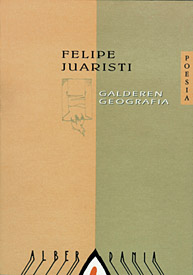
Felipe Juaristi |
GALDEREN GEOGRAFIA
Publisher: Alberdania
|
|
 BRIEF BIBLIOGRAPHIC AND BIOGRAPHIC OVERVIEW: BRIEF BIBLIOGRAPHIC AND BIOGRAPHIC OVERVIEW:
Felipe Juaristi Galdos (Azkoitia, 1957). After graduating in Journalism in Madrid, he has worked in the field of journalism in both Euskera and Spanish. Founder of the periodicals Literatur Gazeta and Porrot.
In terms of his literary work Galdos is best known for his poetry. His first book of poetry was Denbora, nostalgia (Baroja, 1985). He then wrote and published Hiriaren melankolia (Baroja, 1987) and Laino artean zelatari (Alberdania, 1993). He has also written several works of prose, including Intzentsua lurrean bezala (Baroja, 1988) and Ilargi lapurra (Erein, 1994) as well as a novel entitled Arinago duk haizea, Absalon (Erein, 1990).
NOTES ON AWARD-WINNING WORK:
Felipe Juaristi is on a search to try and understand the pain and affliction of the worlds we are familiar with. He bases his search on questions, and shies away from certainty, feeling that certainty today is just another facet of lies and fanaticism. With his short profound poems the author analyses reality from diverse perspectives and multiple points of view, since this reality is too complex to be seen from a single perspective. In his interior journey, hope changes to desperation, pessimism to optimism, as if they were seasons, only to arrive at the end of the journey full of doubts and uncertainties, just like the beginning of the journey.
| EUSKADI PRIZE FOR LITERATURE IN SPANISH |
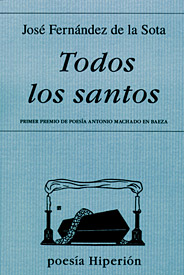
José Fernández de la Sota |
TODOS LOS SANTOS
Publisher: Ediciones Hiperión
|
|
 BRIEF BIBLIOGRAPHIC AND BIOGRAPHIC OVERVIEW: BRIEF BIBLIOGRAPHIC AND BIOGRAPHIC OVERVIEW:
José Fernández de la Sota (Bilbao, 1960). The award-winning work was also given the "Antonio Machado" Prize for Poetry in 1997 in Baeza (Jaén), then published by Hiperión as part of its poetry collection, issue number 308.
In 1988 poet Fernández de la Sota was awarded the "Alonso de Ercilla" Prize for Poetry convened that year by the Basque Department of Culture for his work Te tomo la palabra. Since that time he has continued written poetry in the poetry journal Zurgai from the collection Los Pliegos del Norte, as well as writing his own books, positioning himself among the most outstanding poets of his generation. Prior to this award-winning work, he wrote the following books of poetry: Te tomo la palabra (Bilbao, Laida, 1989), La gracia del enano (Seville, Renacimiento, 1994) and Esto no es un soneto (Málaga, Rafael Inglada Ed., 1996). For his fiction work, he was awarded the "Max Aub" and "Gabriel Aresti" Prizes for short stories and published the novel Informe Goliat (Bilbao, Laida, 1989). He has recently published a long story entitled Negrita con diamantes (Valencia, De. Pre-Texts). Twenty of his poems have been translated into the Russian and published.
NOTES ON AWARD-WINNING WORK:
More than a book on death, Todos los santos is a book of possible lives: farmers drained by the sun, card-sharps down on luck, careless suicides, people who one day decide not to get out of bed, travel agent employees who travel only in their imaginations, saints and sharpshooters who train their sights on their victims.
Each one tells us his or her version of the story-of their story-from their own tomb, from their own personal and moral standpoint. "Nobody has ever told about their death while still alive" says one of the characters in the book. So, with a serious and ironic tone, they therefore talk about life in the poems in Todos los santos. On the same earth, in the same cemetery, are gravestones engraved with such names as Wallace Stevens, Max Brod, Emily Dickinson, Gustavo de Maeztu or Irineo Tristán, the last Mexican put to death in the United States.
| EUSKADI PRIZE FOR YOUNG PEOPLE'S LITERATURE |
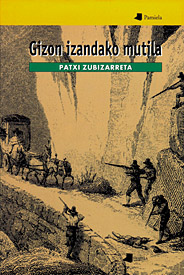
Patxi Zubizarreta |
GIZON IZANDAKO MUTILA
Publisher: Pamiela
|
|
 BRIEF BIBLIOGRAPHIC AND BIOGRAPHIC OVERVIEW: BRIEF BIBLIOGRAPHIC AND BIOGRAPHIC OVERVIEW:
Patxi Zubizarreta Dorrondoso Born in Ordizia (1964). Professionally a writer of young people's literature. He currently lives in Vitoria-Gasteiz, where he took his degree in Basque Philology.
The greater part of his literary work focuses on children's literature.
Besides the award-winning work, Gizon izandako mutila (Pamiela, 1997) , he has also written the following books:
Ametsetako mutikoa (Elkar, 1991), Matias Ploff-en erabakiak (Erein, 1992), Gutun harrigarri bat (Elkar, 1992), Emakume sugearen misterioa (Alberdania, 1993), Ipuinkari (Pamiela, 1994), Marigorringoak hegan (Edebé, 1994), Jentzi (Erein,1993), 1948ko uda (SM, 1994), Eztia eta ozpina (Alberdania, 1995), Ilargia ditarean (Elkar, 1996), Enara, zer berri? (Alberdania, 1996), Sekretuen liburua (Alberdania, 1997)
He has also translated a number of classical young people's stories into Euskera:
Ali Baba eta berrogei lapurrak (Pamiela, 1993), Aladin (Pamiela, 1995), Sinbad (Pamiela, 1996)
NOTES ON AWARD-WINNING WORK:
Even when he was called Antonio María, everyone, except for Fabián, called him Gizon izandako mutila ("The boy who was a man").
Fabián, who everyone, except for Antonio María, called Tximino ("The Monkey"), tells us the origin and history of Gizon izandako mutila. He also explains what led him to become a bandit, his adventures, the company he kept and exactly what happened in a town in the Pyrenees after his hazardous escape.
| EUSKADI PRIZE FOR THE BEST TRANSLATED WORK INTO EUSKERA |
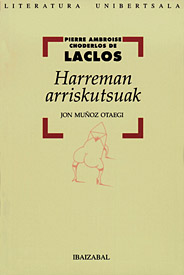
Jon Muñoz Otegi, (Declos) |
HARREMAN ARRISKUTSUAK
Publisher: Ibaizabal-Literatura Unibertsala
|
|
 BRIEF BIBLIOGRAPHIC AND BIOGRAPHIC OVERVIEW: BRIEF BIBLIOGRAPHIC AND BIOGRAPHIC OVERVIEW:
JON MUÑOZ OTAEGI (Donostia, 1961). Translator who studied in the School of Translation of Donostia-San Sebastián. Contributor to LUR Hiztegi Entziklopedikoa (LUR Encyclopaedic Dictionary), and to LUR Entziklopedia Tematikoa (LUR Thematic Encyclopaedia). Among other translations, his most noteworthy are those done for the magazine Nosferatu. He has also translated a number of comics (Gabai saila, LUR). This award-winning work is the first of a number of literary works he has translated and had published.
| DISTRIBUTION PRIZE |
Xabier Montoia |
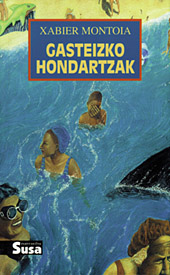
GASTEIZKO HONDARTZAK
Publisherl:Susa
|
|
 BRIEF BIBLIOGRAPHIC AND BIOGRAPHIC OVERVIEW: BRIEF BIBLIOGRAPHIC AND BIOGRAPHIC OVERVIEW:
Other works by Xabier Montoia:
Anfetamiña (poetry, 1983)
Likantropo (poetry, 1985)
Narraztien mintzoa (poetry, 1988)
Non dago Stalin? (fiction, 1991)
Emakume biboteduna (stories, 1992)
Gasteizko hondartzak (1997)
Plastikozko loreak Erregearentzat (feature, 1998)
NOTES ON AWARD-WINNING WORK:
Gasteizko hondartzak is not just a book of stories, nor is it a novel. And it isn't a history book. Yet somehow it blends all three aspects into an excellent narration. It describes a century in the life of Vitoria-Gasteiz-from 1893 to the present. The main characters are the men and women who live in the city. Xabier Montoia has woven a thick cloth whose fibres are the citizens of 20th century Gasteiz. For the first time in Basque literature, the geography of the city and the feelings of the people come together to make up a subtle, yet at the same time generic story.
|