|
|
1999
| Euskadi prize for literature in euskera |
Anjel Lertxundi |
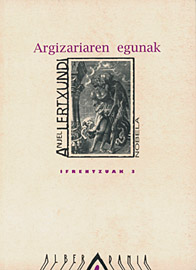
ARGIZARIAREN EGUNAK
Publisher Alberdania |
|
 Brief Biliographic and Biographic Overview: Brief Biliographic and Biographic Overview:
ANJEL LERTXUNDI (Orio, 1948). Studied teacher training, Philosophy and Letters in Donostia-San Sebastián, Rome and Valencia. He has worked in the field of education and in journalism. Writer and screenwriter for television. His book of stories, Hunik arrats artean (Lur, 1970) was his first book to be published. Since then, along with the publication of novels and storybooks, his literary work has included young people's literature, essays and newspaper columns. Among his most noteworthy works are Goiko kale (Gero, 1973); Aise eman zenidan eskua (Erein,1979); Tristeak konsolatzeko makina (Erein, 1981) Hamaseigarrenean aidanez (Erein, 1983), Tobacco days (Erein 1887) Carla (Erein, 1989); Kapitain Frakasa (Erein, 1991); Otto Pette (Alberdania, 1994), Piztiaren izena (Alberdania, 1995), Azkenaz beste (Alberdania, 1996) and Letrak kalekantoitik (Alberdania, 1996).
Much of his work has been translated into Spanish and some of his stories have also been published in English, French and Italian. In 1982 he was awarded the Euskadi Prize for Literature for his novel, Hamaseigarrenean aidanez, which was later made into a film.
Notes on award-winning work
Argizariaren egunak is part of the tetrology Ifrentzuak (ifrentzu = reverse, back); to end the series Lertxundi decided to write a novel. In this book the author offers us an innovative type of narration in which he uses a number of stories and points of view to create a brilliant mirror game.
Lertxundi's mirrors do not provide us with a one-dimensional image, but rather urge the reader even deeper. The elasticity of a soft candle mingles with death, love and madness in a tender dance. And what could be a more direct metaphor for the malleability of human life and death than wax?
LThe tetralogy Ifrentzuak mixes European oral and written tradition. These traditions are turned upside down and Lertxundi then constructs new ways to create over them. Traditional age-old eternal themes are recreated in a modern attractive style. Each theme is worked monographically, with their different heads and tails, styles, tones, moments and ways of writing.
| EUSKADI PRIZE FOR LITERATURE IN SPANISH |
Bernardo Atxaga |
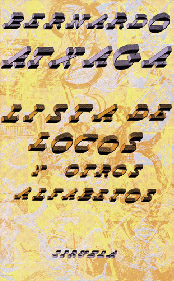
LISTA DE LOCOS Y OTROS ALFABETOS
Publisher: Siruela |
|
 Brief Biliographic and Biographic Overview: Brief Biliographic and Biographic Overview:
Bernardo Atxaga - José Irazu Garmendia - (Asteasu, 1951). Graduate in Economics in Bilbao, he studied Philosophy at the Universidad Central in Barcelona. Atxaga has worked as an economist, Euskera teacher, bookseller, printer employee and radio scriptwriter, among other things, until in 1980 he made literature his main profession.
His first text was published in 1972 with the support of Gabriel Aresti. In 1976 his first short story, Ziutateaz, was published, and in 1978 his first book of poetry, Etiopía; both of these works received prizes from the critics in the Basque Country. The book of stories Obabakoak (Erein 1988) earned him great recognition and a number of awards including the Spanish National Literature Prize. So far the book has been translated into 16 languages; five more are ready to enter the world of Obaboa.
Atxaga has explored different literary formats: novels, Behi euskaldun baten memoriak (Pamiela, 1991), Gizona bere bakardadean (Pamiela, 1993); short novels, Bi anaia (Erein, 1985), Bi letter jaso nituen oso denbora gutxian (Erein, 1985), Henry Bengoa inventarim, Sugeak txoriak begiratzen dionean, Zeru horiek (Erein, 1995), Sara izeneko gizona (Pamiela 1996); poetry, Etiopia (Pott, 1978), Nueva Etiopia (Detursa, 1997); children's literature, Chuck Aranberri dentista baten etxean (Erein, 1985), Nikolasaren abenturak, Ramuntxo detektibe (Elkar 1979), Siberiako ipuin eta kantak, a collection of four stories published by Erein - Jimmy Potxolo, Antonino apreta, Asto bat hipodromoan, Txitoen istorio, Flammery eta bere astokiloak (Elkar), Xolak badu lehoien berri (Erein, 1995), Xola eta basurdeak (Erein 1996) - winner of the 1997 Euskadi Prize for Young People's Literature-, Mundua eta Markoni (BBK fundazioa, 1995); alphabet: Zuk-zuk jaunaren alfabeto berria (Zirriska, 1995), Groenlandiako lekzioa (Erein, 1998) and Lista de locos y otros alfabetos (Siruela, 1998), recipient of this prize; drama: Logalea zuekan ekilibristaren kasoa (made into a film by Maskarada), Henry Bengoa inventarim (made into a film by Hika) Emigración, 1 (made into a film by Geroa), Shola eta lehoiak (currently being made into a film by Porpol).
Bernardo Atxaga generally writes in Euskera and is also the author of some of his versions in Spanish. Following the example of Obabakoak, a number of his other works have been translated into different languages. His works are written up in newspapers and magazines the world over.
Notes on award-winning work
"It is said that the monks of about eight or nine centuries years ago had to face distant, and at times hostile peoples who were always reluctant to march to the beat of a theological demonstration or a moral condemnation, and that from this difficulty and the need to overcome it the Alphabetum enxiempla were born. The idea was to try and distribute the weight of the many discourses, and for each of the twenty-some letters of the corresponding alphabet to help carry the load: 'A' would demonstrate the existence of 'Alma' (Soul) for example, or the letter 'B' would speak for Saint Basil (...). When one of these alphabets fell into my hands, I was already prepared to understand what the verbal device was for (...). So, with virtually no hesitation, I decided to appropriate the method; a year went by and my alphabets were already being read in the most unusual places. My friends began to get worried."
This is Bernardo Atxaga's explanation on how the idea came about to write up these fifteen alphabets, which, different from the alphabets of the medieval monks, do not deal with religious matters but rather with literature and with ways of storytelling; in a word, of dealing with language. The collection is a fantastic theatre of letters where each one initiates us in the mysteries of reading, in a lively game for the reader, in which behind every letter there are concepts, memories and yearnings.
This is a brilliant collection of texts, half narrative, half didactic, very modern and at the same time ancient. They takes us from Basque literature to Borges, from the revenge of Plagio to a Song of the seas, all with the originality and freshness that can always be found in Atxaga's work.
| EUSKADI PRIZE FOR YOUNG PEOPLE'S LITERATURE |
Juan Kruz Igerabide |
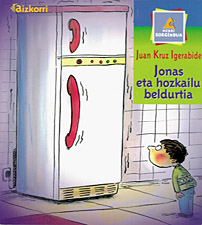
JONAS ETA HOZKAILU BELDURTIA
Publisher: Aizkorri
|
|
 Brief Biliographic and Biographic Overview: Brief Biliographic and Biographic Overview:
Juan Kruz Igerabide (Aduna, 1956). Professor at the University of the Basque Country. Igerabide is a writer specialising in young people's literature and has also explored other literary areas. He has published a book of poetry, Sarean leiho (Alberdania, 1994) and a book of aphorisms, Herrenaren arrastoan (Alberdania, 1998).
Most of his work has been in young people's literature, working from different genres. Poetry: Begi-niniaren poemak, (Erein, 1992) Stories: Tilin-talan (Elkar, 1992), Egunez parke batean (Grigor eta erlearen ipuinak) (Alberdania, 1994), Gauez zoo batean (Grigor eta erlearen ipuinak) (Alberdania, 1995), Denboraldi bat hospitalean (Grigor eta erlearen ipuinak) (Alberdania, 1995), Oporraldi bat baserrian (Grigor eta erlearen ipuinak) (Alberdania, 1996), Neskatxa telepatikoa (Edebé, 1996), Andretxo bizardunaren uhartea (Edebé, 1997); short novel: Gau-gau-gau, co-written with Karlos Linazasoro (SM, 1997) (Bapore Saria, 1997); story: Atea koxkox (Elkarlanean, 1997); poetry: Bota ura (nire terrazatik) (Edebé, 1997), Haur korapiloak (Pamiela, 1997); Kartapazioko poemak- also co-written with Karlos Linazasoro (Ibaizabal, 1998); story: Ametsontzi, (Elkarlanean, 1998).
A number of Igerabide's books have been translated into Spanish and Catalan.
Notes on award-winning work
This story tells about the fear felt by a three-year-old child named Jonás, when he is left along while his mother goes out to do the shopping.
| EUSKADI PRIZE FOR THE BEST TRANSLATED WORK INTO EUSKERA |
Juan Garzia Garmendia (Jorge Luis Borges) |
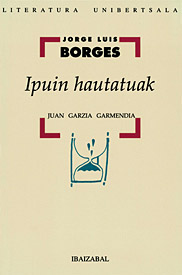
IPUIN HAUTATUAK
Publisher: Ibaizabal - Literatura Unibertsala
|
|
Brief Biliographic and Biographic Overview:
JUAN GARZIA GARMENDIA (Legazpi, 1955). Graduate in Hispanic Philology from the Autonomous University of Barcelona. He is writer, translator and professor. From 1992-1993 he served as president for EIZIE, the Basque Association of Translators, Editors and Interpreters.
Garmendia has worked professionally in different areas of translation, including theatre (with translation for the groups Bederen-1 and Hika of works such as Eclipse by Vallejo-Najera, El relevo by Celaya and Alpargatak euria ari duenean, based on a collective text by U.S. actors), and fiction: Na Lionor/ Lierni by Esteve Caseponce (Erein-Auskalo 1986), Bartlebi, the Scrivener / Bartleby izkribatzailea by Herman Melville (Erein, 1991) - which won the Orixe Prize for Translation-, Shakespeare`s sonnets / Soneto hautatuak (Alberdania, 1995), Le dégré zéro de l`écriture / Idazkuntzaren zero gradua and Le plaisir du texte / Testuaren atsegina by R. Barthes (Classics on Thought, 1996), The man who was Thursday / Ostegun izan zen gizona by G.K, Chesterton (Ibaizabal, Literatura Unibertsala bilduma, 1997), Sistema periodikoa (translation of the work by Primo Leviren, Alberdania, 1998).
He has also been active in literary creation with works such as Pernixio (winner of the Ignacio Aldekoa Prize for Stories, published as part of the anthology Euskal ipuinen antologia bat coordinated by Iñaki Aldekoa-Alberdania, 1993-); Akaso (Erein, 1987); Kristo, a story included in Tabernako zulokoak (Erein, 1990); Gabonak Gubbio-n (winner of City of Irun Prize for Stories, 1991, published by Kutxa in 1992), Itzalen itzal (1993), Sudur puntan mundua (winner of the Antonio Mª Labaien competition in 1994, published by Alberdania, 1994) and the novel Fadoa Coimbran, (Alberdania,1995).
In the area of essays, he has published Txirritaren Baratzea norteko trenbidetik (Alberdania, 1997) and Joskera lantegi (IVAP,1997).
Notes on award-winning work
In this book, Juan Garzia Garmendia has compiled and translated 26 stories written by Argentine author Jorge Luis Borges (1899-1986): La supersticiosa ética del lector / Pierre Menard, autor del Quijote/ La lotería en Babilonia / La Biblioteca de Babel / El jardín de senderos que se bifurcan / Funes el memorioso / Tema del traidor y del héroe / El sur / El inmortal / Los teólogos / Emma Zunz / El Aleph / El pudor de la historia / Diálogo sobre un diálogo / Argumentum ornithologicum / La trama / Borges y yo / In memorian JFK / El evangelio según San Marcos / Hengist quiere hombres / Episodio del enemigo / El Congreso / El espejo y la máscara / El disco / El libro de arena / Epílogo
Borges' peculiar style makes it possible to enjoy a broad overview of his narrative work in a single book. Ipuin hautatuak offers us 26 pieces which have changed the literary moulds of the 20th century. The stories are in chronological order the selection of which is meant to represent the main lines of Borges' work (in some cases we are dealing with much more than a story), and for providing a coherent and attractive book. In addition to bringing together as broad a sample as possible of Borges' prose, in this anthology an effort has been made to offer a truly enjoyable read.
The work has been translated as part of the "Colección Literatura Unibertsala" promoted by the Basque Department of Culture and EIZIE, the Basque Association of Translators, Editors and Interpreters; this organisation aims to create a collection of works of universal literature translated into Euskera.
| DISTRIBUTION PRIZE |
Andoni Egaña |
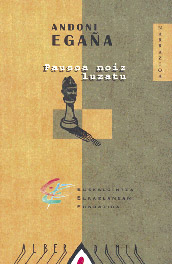
PAUSOA NOIZ LUZATU
Editorial: Alberdania
|
|
 Brief Biliographic and Biographic Overview: Brief Biliographic and Biographic Overview:
ANDONI EGAÑA (Zarautz, 1961). Studied Basque Philology at the University of the Basque Country in Vitoria-Gasteiz. Bertsolari. He is two-time bestsolari champion of Euskal Herria (1993 and 1997). His book of stories Sokratikoek ere badute ama (Erein, 1989) was his first work to be published, followed a year later by the collection of newspaper articles entitled Aitaren batean (Elkar, 1990). In 1997, the epistolary style Zozoak beleari (Alberdania, 1997), written jointly with Jon Sarasua, was published.
Notes on award-winning work
Jaca, December 1930. Capitan Galán and the aviation soldiers under his command are ready to rebel in favour of the Republic. The captain will pay with his life for moving too soon.
Zarautz, 1960. The friar who founded and is director of the Vocational School awaits the car that will take him to Madrid. Carrying a suspicious gift, he plans on picking up the prize that Franco will be awarding the School. Some think this step is way too big and others, too small.
The novel is not merely an account of two moments in history, although it is that too. We learn that the friar from Zarautz is one of Capitan Galán's rebels. Yet, although it does paint a multifaceted picture of this character, the novel is not the biography of Friar Cándido.
The Jaca rebels are tragic heroes ready to die for the Republic. Friar Cándido, on the other hand, does not want to be a hero. He has his own utopia and is willing to risk almost anything in order to go on living for it, according to the people who know him best.
In this book, Andoni Egaña uses his natural talent to tell this historical story with vivid details.
|