|
|
2000
| "Euskadi" prize for Literature in spanish |
Lourdes Oñederra |
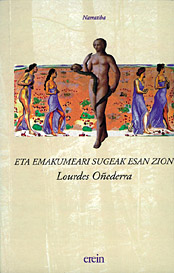
Eta emakumeari sugeak esan zion
Erein,1999
|
|
 About the autor About the autor
Lourdes Oñederra was born in San Sebastián in 1958. She earned a Bachelor's degree in Hispanic Philology at the University of Deusto and a Doctorate in Basque Philology at the University of the Basque Country. In addition to teaching, she has also been involved in a number of literary publications.
www.lourdesonederra.com/euskera/biografia.html
Awarded for
"ETA EMAKUMEARI SUGEAK ESAN ZION" (mírme si hay que poner alguna de estas palabras con mayúscula). Erein, 1999, 184 p. It is as if Lourdes Oñederra simply waited long enough so that she could use the fibres of her memory to weave an extraordinary plot, the kind we usually associate with writers who have a number of works under their belts. It is surprising that she managed to come up with such an intense story for her first novel. This book not only won her the Critics Award, but also captivated so many readers in its courageous and risky account of the confessions of a married woman. Revolving around the feelings and experiences written down in a diary and divided into the four seasons, a woman in her mid-forties examines every detail of her life. She speaks candidly about love, weariness, tedium and friendship at a time when childhood memories have begun to fade into the distance. She is compelled to examine the memories she does not understood over and over again. In "Y la serpiente dijo a la mujer" (And the snake told the woman) we are told that life may very well be a process of remembering. The author uses this title to take a look at the world of women who cast their doubts over love when their bodies have already grown weary. This is a path on which we all look for shelter and are all busy trying to understand life, time and other biological or sentimental ties.
This book, recently selected for the National Prize, has been given the following awards: 1999 Critics Award, 1999 Beterriko Liburua Prize, 2000 Euskadi Second Prize.
Translated into Spanish "Y la serpiente dijo a la mujer" Publisher: Bassarai, 2000, 144 p.
| "Euskadi" Prize for Young People's Literature in Euskera |
Felipe Juaristi Galdós |
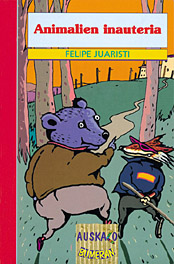
Animalien Inauteria
Erein
|
|
 About the author About the author
FELIPE JUARISTI GALDOS (Azkoitia, 1957).
After graduating in Journalism in Madrid, he has worked in the field of journalism in both Euskera and Spanish. Founder of the periodicals "Literatur Gazeta" and "Porrot".
In terms of his literary work Galdos is best known for his poetry.
His first book of poetry was "Denbora, nostalgia" (Baroja, 1985). He then wrote and published "Hiriaren melankolia" (Baroja, 1987) and "Laino artean zelatari" (Alberdania, 1993). He has also written several works of prose, including "Intzentsua lurrean bezala" (Baroja, 1988) and "Ilargi lapurra" (Erein, 1994), as well as a novel entitled "Arinago duk haizea, Absalon" (Erein, 1990).
In terms of young people's literature his works include "Tristuraren teoria" (Erein, 1993), "Ilargi-lapurra" (Erein, 1994), "Sagitario" (Desclée de Brouwer, 1995), "Eguzkiaren Etxea" (Alberdania, 1998) y "Laura eta Itsasoa" (Aizkorri, 1998). Jauristi's works have won a number of different awards, including the Lizardi Prize (1992) for "Tristuraren teoria". In 1998 he was given the "Euskadi" prize for literature in Euskera for a book of poems entitled "Galderen Geografia,"also published in Spanish with the title "Geografía de las Preguntas" (Bassarai, 1999).
Notes on the award-winning work
Mr Bear woke up, got out of bed, had a stretch and put on a pair of black trousers, a heavy plaid shirt and a sweater. Then he put on his boots and immediately lit the fire to heat up a pot of water. After having his morning cup of coffee, he went to the window to have a look outside; everything was covered with dew. He put on a jacket just be safe, put his glasses in a safe place and stepped outside. Off in the distance through the mist he could make out the house of his friend Mr Fox, who had left five days earlier without saying a word. Someone had even suggested that he might be dead. But that morning, surprisingly enough, smoke could be seen rising from his chimney. His friend Mr Fox had come back!
| "Euskadi" Prize for Literature in Spanish |
Paloma Diaz-Mas |
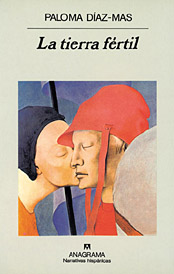
La Tierra fértil
Anagrama
|
|
 About the author About the author
http://www.anagrama-ed.es/palomadiazmas/
PALOMA DÍAZ-MAS (Madrid, 1954)
Paloma lives in Vitoria-Gasteiz, where she is professor of Spanish and Sephardic Literature at the University of the Basque Country. In addition to the prize-winning book, her other published works are "El rapto del Santo Grial" (Anagrama, 1984); "El sueño de Venecia" (Herralde Prize for Best Novel, 1992); a collection of stories called "Nuestro milenio" (Anagrama, finalist in the National Prize for fiction, 1987); and a travel book entitled "Una ciudad llamada Eugenio" (Anagrama, 1992). Her stories have appeared in a number of storybooks, including "Madres e hijas" (Anagrama, 1996). An expert in Hispano Jewish and Sephardic literature, she has also written "Los sefardíes: Historia, lengua y cultura" (Riopiedras, 1997), "Poesía oral sefardí" (Sociedad de Cultura Valle-Inclán, 1994) and, together with Carlos Mota, a compilation of proverbs entitled "Proverbios morales de rabí Sem Tob de Carrión" (Cátedra, 1998). She has also published an anthology of romances (Crítica, 1994). (Sources: La tierra fértil, Publisher: Anagrama).
Notes on the award-winning work
"La tierra fértil" by Paloma Díaz-Mas, Anagrama, 1999, ?? p. Some might say that "La tierra fértil" is a portrait of a feudal society: 18th century Catalonia. Others will see it as the tale of a chain of passions, friendships, treason, love, hate, justice, fidelity, rebelion, violence, mistakes and regrets. To some it is the biography of Arnau de Bonastre, a tormented man whose life - like a wheel of fortune - spins round and round, moving from power and safety to decadence and misery. To some readers, the novel could even be an Oedipal adventure which shows how children (first Arnau de Bonastre, then his own sons Raimón Amat and Oliver Ull Blau) always rebel against their parents even though they might later carry the ominous burden of guilt. Some people will discover in this story a recreation of the Cain and Abel legend, seeing the main theme as brotherly stuggle.
Perhaps the backbone of the entire novel is the process of a man who learns to love the man he has most hated; or how a traitor can be faithful in the same way a friend can turn into the worst enemy. Or maybe it is how evil, once set loose, strikes not only its victims but also those who create it and those who with the best of intentions try to stave it off.
However, what is told here might also be nothing more than men and women - either medieval or those of today - struggling to survive in a difficult world. In this struggle everyone comes together: the tyrannical, fuedal, forgiving, handsome and mysterious Arnau de Bonastre; the wretched yet gentlemanly Bertrán Guerau, Bonastre's friend and enemy; Bernat Armengol, guide and teacher, upright but somewhat cold; Guifré de Castelnau, the pious heretic; the artesan Joan Galba, thrown against his will into a world of chivalry; Vidal Girondí, the Jewish doctor; and either dominated or arrogant women - Elisenda Guerau, Tibors de Fenal, Margarida la de Pere Galba and Sibila de Armengol - whose presence, more than anything else, is silent tension. But there is another presence even more silent: the peasants bound to a piece of land which is their precarious means of survival as well as their yoke. With any stupid idealisation of the past we know that "cruel necessity has always enslaved men, leading them to turn their own history into a sterile nightmare."
| "Euskadi" Prize for the best translation into Euskera |
Irene Aldasoro |
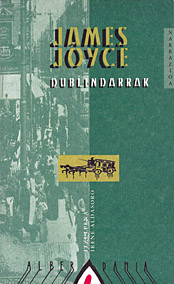
| James Joyce - Dublindarrak |
|
 About the author About the author
Irene Aldasoro was born in Idiazabal in 1955. She teaches Basque and does literary translations as well as translate texts for the Basque television station, ETB. Her translations include: "Artistaren gaztetako portreta" by James Joyce, Literatura Unibertsala, 1992; "Birjina eta ijitoa"by D.H. Lawrence, Literatura Unibertsala, 1994; "Europarrak" by Henry James, Literatura Unibertsala, 1998; "Hemeretzi ipuin" by H.C. Anderson, Literatura Unibertsala, 1997 (several translators); "Dublindarrak" by James Joyce, Alberdania, 1999.
The award-winning translation, "Dublindarrak" is not merely a collection of fifteen stories, but rather a book characterised for its unity. The stories, far from being images or caricatures of different citizens, is heavily symbolic with a formal mien. Each of the stories complement and enriches the rest. The plentitud of the work and the interrelation between the parts is clear once the entire book is read. The stories are in chronological order: stories of childhood, adolescence, maturity and public life in Dublin. In "Dublindarrak", the first of Joyce's masterpieces, we see the real face of the city, the true foundation and stage for the stories and the people, all identified by name. Joyce clearly denounces the weak society, paralysed and clinging to tradition. Joyce watches and takes notes on the daily lives of these people, remaining very objective but never giving his opinion on their behaviour.
|
|
|