This grand town was once the Kingdom's capital because the Kings of Navarra chose it for their residence in the 12th century. To perpetuate this tradition, the Carlists, before being overthrown by the Liberals, proclaimed their pretender to the throne King of Spain here in 1883. From this past, Estella has conserved a rich collection of historical monuments, with at least six churches and two palaces.
San Pedro de la Rua
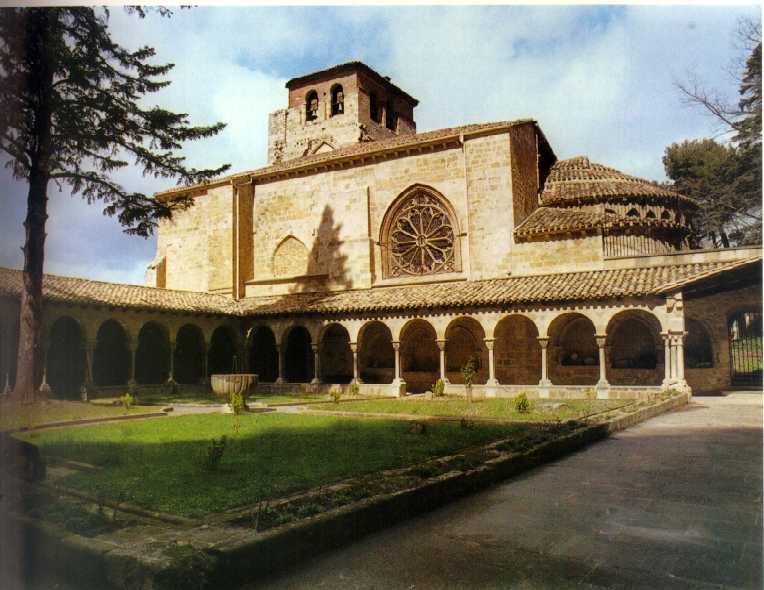
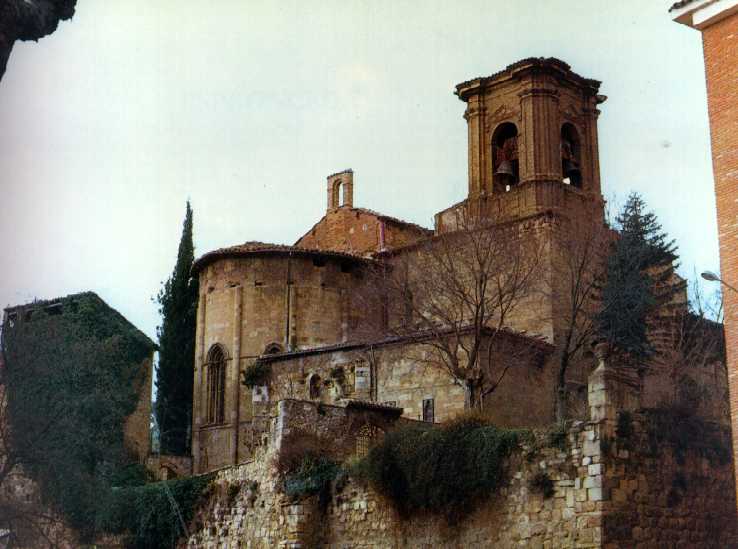
Joined to a vertical rock, the church of San Pedro de la Rua is approached via a monumental staircase that has been admirably adapted to difficult terrain. The staircase leads to a poly-oval lancet arch portico, almost rounded, with ten small adjacent arches, which is exceptional due to its decoration with geometrical motifs clearly inspired by Andalusian Muslim art. The Romanesque cloister, with twin columns and sculpted capitals that represent scenes from the life of Christ and the Saints, was partially destroyed by a deputy of the King of Aragon in 1512, in times of the conquest of Navarra.
Palace of the Kings of Navarra
The Palace of the Kings of Navarra is a very valuable example of Romanesque civil architecture (from the end of the 12th century). It has two storeys, with a third added later, and two small brick towers. It is one of the oldest palaces in the entire country. It has twin windows and a famous capital that represents the fight between two knights, the valiant Roldan and Ferragut, a Moorish hero.
Church of San Miguel
This church rises up on a hillock and was rebuilt in the gothic era, although it conserves a Romanesque portico, richly sculpted with Biblical scenes, under an atrium that darkens and protects it. Especially outstanding are the two pieces of high relief work on each side. One represents the Holy Women reaching the grave of Christ when he rose again and the other Saint Michael fighting with the dragon and weighing souls.