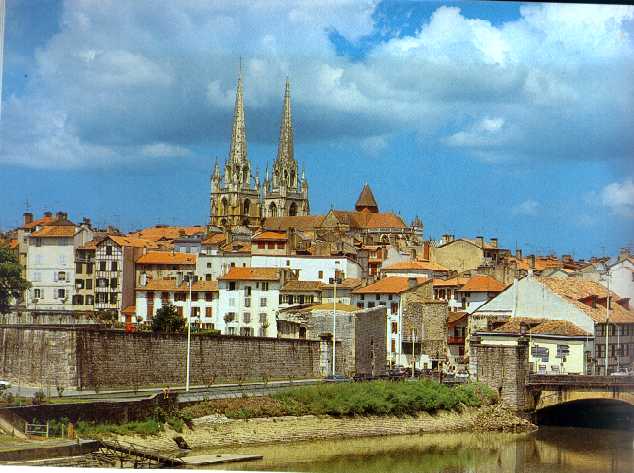
The delightful old quarter of Bayona has three parts: la Grand Bayonne or old Bayona, la Petit Bayone and the Espíritu Santo neighbourhood.
La Grand Bayonne occupies the surrounding area of the hill dominated by the Cathedral. In its narrow streets visitors can frequently find mansions from the 16th, 17th and 18th centuries, such as the Belzunce and Brethous palaces.
Cathedral of Santa Maria
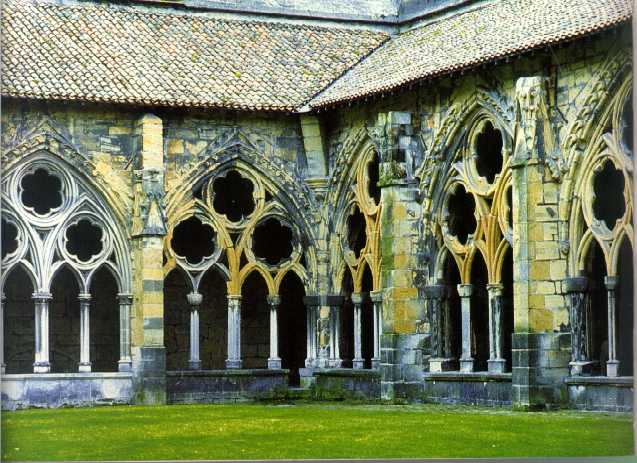
The symbol of prosperity in any mediaeval town is its cathedral. Bayona's cathedral is superb. Building began in the 13th century, with the choir and the ambulatory of five chapels, on the site of the former Romanesque church, which became too small. It was completed in the 16th century, although its 88 metre high spires were not built until the 19th century. It has three naves and six sections. The style is a mixture of radiant and flamboyant gothic. In the central nave, dating from the 14th century, the vault keystones are emblazoned with French lilies and English leopards. In the southern wing of the transept, the prettiest keystone is decorated with the famous ship of Bayona, with its masts, its fore- and after-castles, and five sailors, an expression of the naval power of the town in that era. In the southern tower, in flamboyant gothic style and built during the late 15th and early 16th centuries, the lilies have ousted the leopards. Flanking the cathedral is a vast cloister in radiant gothic style from the 15th century, which served as a meeting and assembly point.
La Petite Bayonne is a picturesque neighbourhood with regular façades and narrow streets which, in the 12th century, began to take ground from the marshlands, conserving the grid-like plans of the old plot divisions.
The Espíritu Santo neighbourhood is dominated by the citadel; this neighbourhood is home to a sizeable Jewish community that reached Spain in the early 16th century and that prospered here.