EUSKALTEL-EUSKADI: THE FANS' TEAM
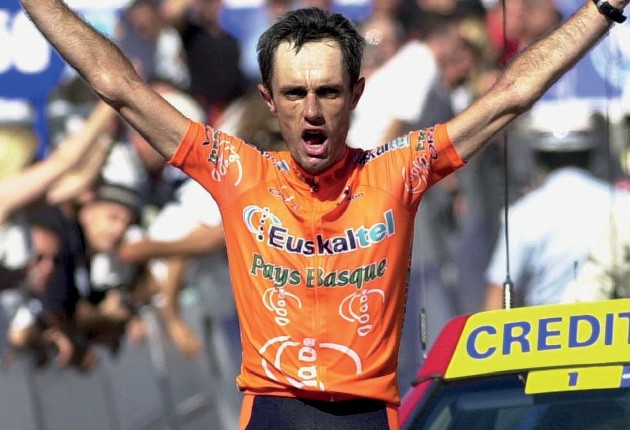
The Euskadi team was born in an amazing way: by popular subscription. In 1994, 3,450 people and 720 companies contributed money to create a professional squad with Basque cyclists. In the early years the project was modest, the riders achieved few victories and sought the limelight in the breakaways (they even earned the nickname "the cyclists of less than ten": because they escaped from the peloton ten minutes before the radio bulletins, so that they would be named in the live connections). The team grew with funding from Basque public institutions and above all with the sponsorship of the Euskaltel telephone company, which changed the white, green and red colours of the jersey to orange, which became the team's hallmark. Euskaltel-Euskadi is a striking case: we remember the team's cyclists, but above all its fans, the orange tide that stained the Pyrenees as the Tour passed by.
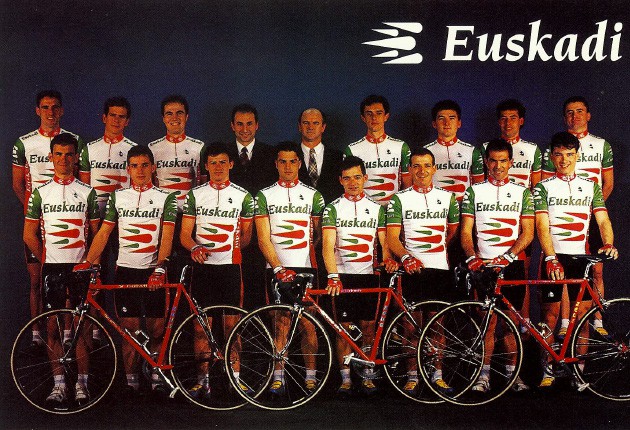
In 2001, when the Euskaltel-Euskadi team took part in the Tour for the first time, only two of its nine riders had competed in the French Tour before: Iñigo Chaurreau and David Etxebarria.
- I'll never forget the first week," says Haimar Zubeldia, one of those rookies, who had already won an Euskal Bizikleta and had finished second in the previous year's Dauphiné, behind Hamilton and ahead of Armstrong. We set off with the desire to make a good classification and in the first week we were caught in all of them. One day there were fans and all the team, except Chaurre, were in the last group, 18 minutes behind. Another day I fell in a terrible pile-up, I arrived at the finish with my jersey destroyed, shredded...
Zubeldia finished his first Tour in 73rd place, more than two hours behind.
- I think it was very important to finish the race, because you learn a lot by suffering. And the Tour is a race that requires experience.
The Euskaltel-Euskadi riders resisted as best they could and in the third week their hopes were awakened: they reached the Pyrenees, the mountain range that was to become the stage for the orange tide for the first time.
David Etxebarria recalls that in the first kilometres of the Tarbes-Luz Ardiden stage he was riding in the last positions of the peloton with Roberto Laiseka. At the front, the attacks started, they were suffering the whiplash at the back, a big breakaway came out and suddenly Laiseka told him:
- David, I've got incredible legs, I've got legs like pure butter. We have to get the team going, I'm going to win the stage today.
Etxebarria was amazed:
- Roberto, what are you saying? That there are twenty guys with a two-minute lead. That this is the Tour, that we've never pulled the peloton...
- I'll win the stage today, you'll see.
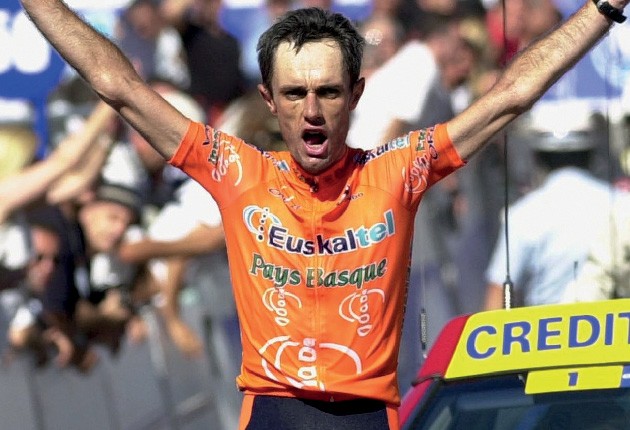
Laiseka insisted and the Euskaltel-Euskadi riders pulled ahead towards a Tourmalet flooded with ikurriñas and orange jerseys. They reduced the gap, Laiseka attacked as they passed through the La Mongie station and chased down the escapees one by one. On the final ascent to Luz Ardiden, he overtook Wladimir Belli, the most advanced of them all, and pressed on with anguish because Armstrong and Ullrich were climbing at full speed, not too far behind, fighting for the yellow jersey.
- Luz Ardiden was crazy," Laiseka recalls. I went up a narrow corridor with Basque fans shouting at me all the time, it was incredible, I finished the stage and they were ringing in my ears.
Haimar Zubeldia, who had been chasing the escapees, climbed up to Luz Ardiden twenty minutes behind the first riders.
- We were climbing and suddenly the whole mountain roared. It was amazing, like celebrating a goal in a stadium, but in the middle of the Pyrenees. People started shouting at us: "Laiseka has won, Laiseka has won!
Not even in the most optimistic forecast would they have imagined such a triumph, on such a stage, in front of their home fans, in the team's first Tour.
And Zubeldia, of course, never dreamed of the scene he experienced two years later on an almost identical stage. Four riders took the lead over the Tourmalet: Armstrong, Ullrich, Zubeldia and his team-mate Iban Mayo. In that 2003 Tour, the Euskaltel-Euskadi riders fought for the yellow jersey, for the most prestigious stages, for a place on the podium in Paris.
- I did dream for a few minutes about the yellow jersey," recalls Zubeldia, who set the fastest time in the prologue held at the foot of the Eiffel Tower to commemorate the first centenary of the race. There were still many riders to come, but none of them beat Zubeldia's time. Neither the specialists such as Ekimov, Rich, Botero or Peña, nor the big names in the general classification such as Armstrong, Ullrich or Beloki managed to do so. In the end Bradley McGee and David Millar beat him by just two seconds.
- We knew we'd get to the Tour well, but not that well," says Zubeldia.
Euskaltel-Euskadi lost three minutes in the very long 69-kilometre team time trial, a difference that would weigh on them in the fight for the podium. But the first big mountain stage turned into a Basque festival. Not only from Euskaltel-Euskadi: Joseba Beloki, from ONCE, more ambitious than ever after three consecutive podiums in Paris, attacked Armstrong on the final climb to Alpe d'Huez and rode away for a good stretch. When he was caught, Iban Mayo counterattacked and flew to the finish, where he won by two minutes and took third overall, close to Armstrong and Beloki. Zubeldia also arrived with the favourites. On a mythical stage like Alpe d'Huez, the Euskaltel-Euskadi riders were among the Tour's main protagonists. And the Pyrenees were still to come.
Zubeldia had a great flat time trial (he was fourth) and a great first Pyrenean stage (he was third in Bonascre, where he attacked a couple of times and even left Armstrong behind).
- My challenge in 2003 was to make it through the third week," he recalls, "and I felt I had the best legs of my life.
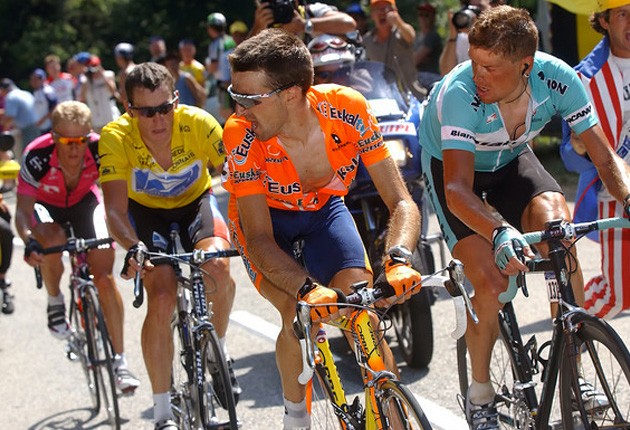
On the queen stage of the Pyrenees, Ullrich attacked halfway up the Tourmalet. First he was caught by Armstrong. Then came Iban Mayo. And a little later, Haimar Zubeldia. All the other favourites (Vinokurov, Hamilton, Basso, Sastre, Menchov...) were left behind.
- I'll never forget that moment," says Zubeldia. I could hardly believe it: we were leading the two kings of the Tour, Armstrong and Ullrich, and two riders from Euskaltel-Euskadi, on the Tourmalet no less! The mountain looked like an orange stadium, the spectators were cheering us on like crazy. And the last straight stuck in my mind. In the race you're like in a bubble, but there I started to identify friends, family and people I knew in the crowd, and in the midst of the shouting I felt an emotion that I've never felt again.
Still, says Zubeldia, they lacked Tour experience.
-We had learned a lot in the first years, but we had never seen ourselves so high up in the overall, fighting for the podium, and that was a new situation for us. And looking back now, I think we should have been more ambitious.
On the descent of the Tourmalet, Armstrong and Ullrich took a break, ate, drank and relaxed their legs a little for the final climb to Luz Ardiden.
-We should have pushed hard," said Zubeldia. We could have eliminated the other podium contenders, but Luz Ardiden was missing, we didn't know how we would respond in a situation like that and we preferred to save our strength. Vinokurov, Hamilton and a few others caught us on the descent.
In a Tour in which Armstrong was showing weaknesses for the first time in many years, Mayo's attacks at Luz Ardiden dynamited the race. Armstrong responded to the first, took the lead, got caught by a spectator and fell flat. Mayo, who was on his wheel, also went down. The others waited with sportsmanship. And shortly after rejoining, Mayo launched the definitive attack. Definitive because Armstrong counterattacked and cleared the doubts: he went alone and won in Luz Ardiden with 40 seconds over Mayo, Ullrich and Zubeldia.
The other podium contenders lost time again, but the gaps were not too big. Vinokurov secured third place in the final time trial, Hamilton climbed to fourth after a very long solo breakaway to Baiona, Zubeldia finished fifth and Mayo sixth. It was Euskaltel-Euskadi's most spectacular Tour.
-It was the first time we were so high up and maybe we lacked the confidence to go for the podium. But our heads clicked, no doubt about it. We felt we were capable of going for it, so the following year we came back with a lot of ambition.
In 2004, Mayo won the Dauphiné, Zubeldia also came with good results in small tours, but the Tour went wrong for them from the start: they lost time in the crashes on the pavé stage, tendinitis sidelined Zubeldia and a virus sidelined Mayo.
- In 2003 we didn't have such high expectations and we had an incredible Tour; in 2004 we were going for it and we both retired. It was a humbling experience. We learned that the Tour is very hard and that everything has to work in your favour: being in shape, not falling, not getting sick... It's not easy to stay at the top every day.
Zubeldia stayed at the top for many years. He took part in sixteen Tours (only four cyclists have done it more times than him) and finished five times in the top ten.
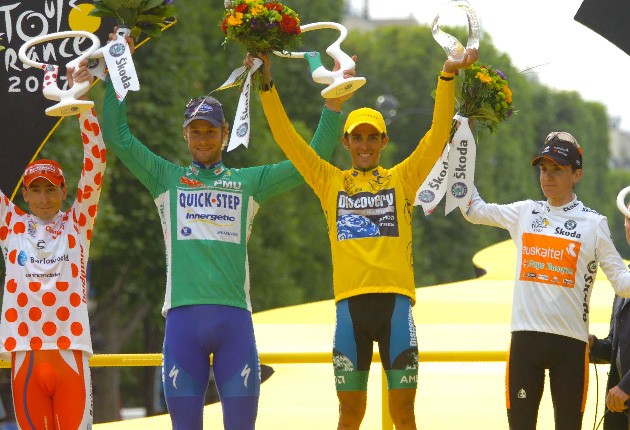
In 2009 he left Euskaltel-Euskadi ("a team in which all the riders lived within a hundred kilometre radius") to join Astaná ("a team with riders from nine or ten countries"), because he wanted to get to know a more global cycling. He worked as a luxury support rider for Contador, who won that Tour, and for Armstrong, who had returned to cycling after his first retirement and finished third, in a very controversial edition due to the confrontation between the two roosters in the same pen. Zubeldia had an unforgettable experience that year: they also won the team classification, so he joined his team-mates on the podium in Paris.
-It was a special moment, a great gift, because I had a love affair with the Tour from the beginning. Despite the slaps in the face in the first year, I realised that it was a race for my characteristics. You have to be resistant, long-distance, complete in the time trial and in the mountains...
Zubeldia did not achieve dazzling triumphs like other cyclists, but he was one of the most tenacious riders. He continued his career in international teams such as RadioShack and Trek, always as a key rider in the French Tour.
- In the Tour you suffer a lot, but it was always my race.
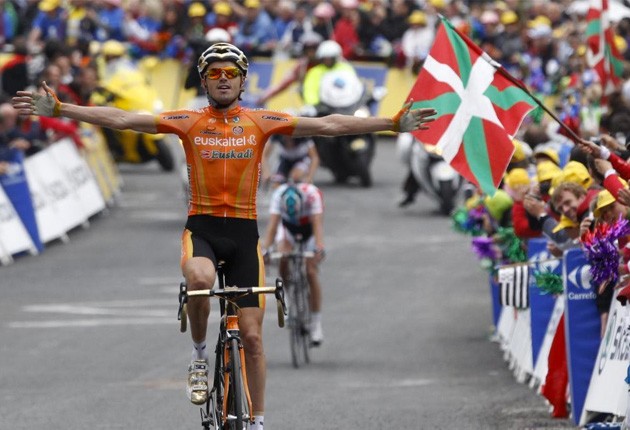
It was also the fetish race for Euskaltel-Euskadi. In the following years the team scored victories such as those of Samuel Sánchez, winner in Luz Ardiden and king of the mountains in 2011, fourth overall in 2010 (second, after the subsequent disqualifications of Contador and Menchov), and always rode the orange waves, those tides of fans that forever stained the Basque memory of the Tour.
Author: Ander Izagirre
Photos: www.fundacioneuskadi.com