Publish date: 2013/11/28
Four out of ten young people play sports three or more times per week
Boys prefer team sports while girls prefer individual sports
 The Basque Youth Observatory presents some data about sport practice among young people aged 15 to 29.
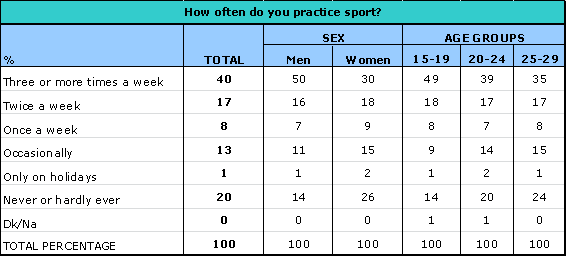
8% of Basque youths practice sport once a week, 17% twice a week and 40% do sport three or more times per week. In other words, most young people practice sport regularly at least once a week (65%).
The regular practice of sport is more widespread among boys (73%) than girls (57%) and increases as age decreases. Age and sex differences mainly affect the percentage of those who claim to practice sport at least three times per week.
By contrast, one in five young people (20%) never or hardly ever practices sport. That means that, together with those who do so only occasionally or when on holiday, one third (34%) of young people do not do any type of sporting activity on a regular basis.
This percentage is significantly higher among girls (43%) than boys (26%) and increases with age, i.e. among those aged 15 to 19, 24% say they never or hardly ever practice sport, or only on holidays or occasionally, and that percentage increases to 36% among people aged 20 to 24 and to 40% among those aged 25 to 29.
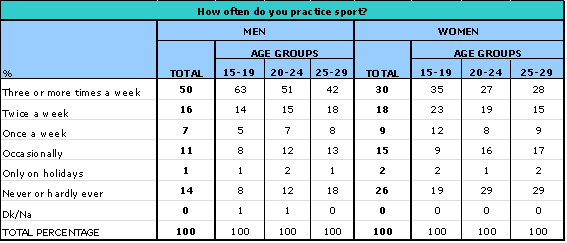
The combined analysis by sex and age shows that while the decline in the practice of sport among boys is continuous as age increases, girls tend to stop practicing sport before they are 20. Consequently, there is hardly any difference between girls aged 20 to 24 and those aged 25 to 29.
This is not surprising considering the limited extent to which sport among women is promoted, the difficulties faced by some girls when transferring from school sport to federated sport and the fact that female sporting successes are hardly ever broadcast by the media. This results in sport not being attractive for young women who, on the other hand, are not socially encouraged to play sports.
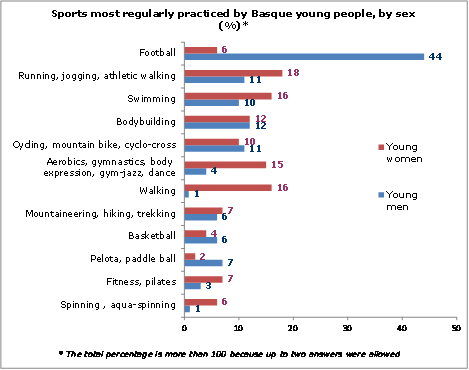
When analysing which sports are most popular among young people in the Autonomous Community of the Basque Country, an analysis by sex is essential. The greatest differences between boys and girls can be appreciated in football where 44% and 6% practise this sport, respectively. Football is the predominant sport among boys, while among girls it occupies the tenth position.
There is not one single sport that brings girls together like football does for boys. The most popular sport practiced by girls is running (jogging...), mentioned by 18%, followed by walking (16%), swimming (16%) and aerobics or similar (15%). These four types of sports, in addition to occupying the top positions on the female list, are practiced more regularly by girls than by boys.
Girls also practice other sports more than football, such as fitness (12%), cycling or bicycle (10%), hiking (7%), gym or pilates (7%) and spinning or aqua-spinning (6%). In the case of pilates and spinning, differences by sex can be appreciated as a greater number of girls practice these sports.
By contrast, young men play pelota and paddle or racquet sports more than girls and the same can be said of indoor soccer and boxing.
Age also makes a difference in the sports practiced. As age increases, the percentage of young people who practice competitive team sports, such as football, basketball and handball, decreases but the number of those who play indoor soccer increases slightly. As age increases, so does the number of young people who go running, walking, trekking, cycling and/or swimming.
People who play sports occasionally or only when on holiday display higher percentages than others in relation to walking, mountaineering, cycling and winter sports.
By contrast, those who play sports three or more times per week present higher figures related to team sport (football, basketball, handball), which usually involves training and matches and, therefore, more sports sessions. They also have higher percentages in bodybuilding activities.
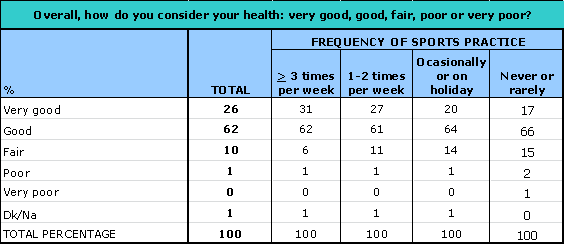
Finally, we must note that people who practice sport more frequently have a better perception of their health, i.e., the number of youths who think they are healthy increases.
These data come from a survey prepared by the Basque Youth Observatory in March 2012 on a representative sample of the Basque youths aged 15 to 29.
Follow us on the social media!

