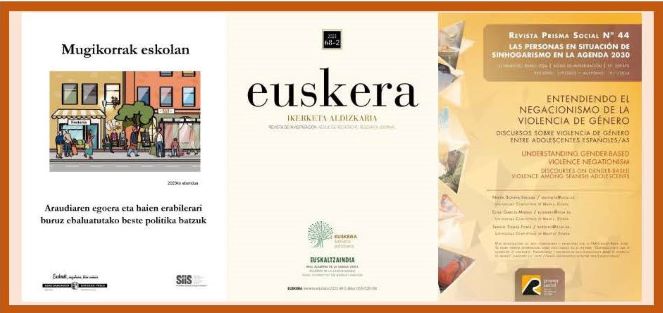
BONETA SÁDABA, N., GARCÍA MINGO, E. y TOMÁS, S., 2024. Entendiendo el negacionismo de la violencia de género. Discursos sobre violencia de género entre adolescentes españoles/a. Prisma Social: revista de investigación social, no. 44, ISSN 1989-3469
This article is the result of a research conducted with adolescents with the aim of understanding their discourses on gender-based violence. It presents the findings of a qualitative research based on seven expert interviews and twelve group interviews conducted with Spanish adolescents. While female adolescents defend critical positions on genderbased violence, male adolescents are closer to post-macho positions. Male adolescents do not completely deny the existence of gender-based violence, but they do minimise its importance. This research note presents three research results: first, a map of the discursive positions of adolescent males and females on gender-based violence; second, a re-construction of the trivialising argument about gender-based violence; and third, what has been called the curved mirror, which is the set of beliefs that adolescent males have about themselves with respect to gender-based violence.
SIIS Social Information and Research Service, 2023. Mugikorrak eskolan. Araudiaren egoera eta haien erabilerari buruz ebaluatutako beste politika batzuk = Mobile Phones at School Regulatory Landscape and Other Policies Assessed. Eusko Jaurlaritza = Basque Government and SIIS.
A recent UNESCO study, Technology in education: a tool on whose terms? (2023)42 estimates that around one in four countries in the world have restricted the use of mobile phones in schools. In this sense, the documentation consulted shows not only a growing international interest in addressing the personal use of mobile phones at school but also a tendency to regulate the use of these devices in educational settings on a territorial scale, beyond the walls of individual schools. Several documents have been reviewed to explore how they proceed in our neighbouring countries and to learn about the policies applied in schools to regulate the use of mobile phones by pupils.
URIONAGUENA, I., FLORES PUGA, B., BIDEGAIN AIRE, E. and ZUBEROGOITIA ESPILLA, A., 2023. Euskal tiktokerren edukiak eta hizkuntzaren lekua (The content of Basque tiktokers and the place of the language). Euskera ikerketa aldizkaria: Revista de Investigación de la Real Academia de la Lengua Vasca, vol. 68, no. 2, ISSN 0210-1564.
The use of TikTok has grown significantly in recent years, becoming one of the most widely used social media networks among Basque youth. In this context, this article examines the position of Basque on TikTok by examining the content of eleven users who create and share content in this language. The study also looks into the motivations for making and sharing videos in Basque through six in-depth interviews.
- Documentation Centre's collection of historical articles
- Further information: geb-liburutegia@euskadi.eus