Articles of interest: the use of Snapchat, the influence of Internet content on body aesthetics, leisure among Spanish youths
Fecha de publicación:
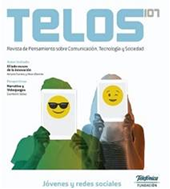 RUBIO-ROMERO, Juana y Marta PERLADO LAMO DE ESPINOSA. Jóvenes y redes sociales. Snapchat o el impacto del contenido efímero. Revista TELOS. Cuadernos de Comunicación e Innovación. Madrid: Fundación Telefónica, 2017 junio septiembre, p 1-9, ISSN 0213-084X (article available in Spanish)
The figures regarding the use of Snapchat since it was launched are growing exponentially. It allows the exchange of images on social networks through an instant messaging system. Its functions have evolved from the disappearance of the messages to the appearance of other features (Memories) that allow the preservation of Instagram Stories or to the possibility of adding layers that allow users to express emotions, humour, and creativity. It covers private and social communications and opts to produce content designed for entertainment. The sender chooses how long and the number of times that the recipient can view the contents; the sender loses control over the content once it has been sent and the recipient can capture it and save it; however, the sender is aware of this. The messages consist of images or videos to which other objects are added. It reports the number of times that the content has been viewed, not the number of people who have viewed it. Privacy is in question because the recipient can capture and preserve the message. The Snapchat style is defined as natural, relaxed, and spontaneous. Snapchat is an innovative social network that is characterized by the ephemeral and immediate nature of the messages; it breaks with the idea of permanent social networks as repositories. Young people appreciate it as a real application, and also as absurd because whatever they upload disappears. It resembles a light-hearted and spontaneous bar conversation, through which you can display an interest in daily life and entertainment, and express feelings.

 ECHEGARAY EIZAGUIRRE, Lázaro, Carmen PEÑAFIEL y Milagros RONCO. La influencia de los contenidos de Internet en la construcción estética corporal en los jóvenes y adolescentes vascos y navarros. Ámbitos. Revista Internacional de Comunicación (38), 2017. ISSNe 1139-1979 (article available in Spanish)
Young people from the Basque Country and Navarre seek information on the Internet about health issues but understand that not much education can be obtained from these websites given the powerful influence of marketing. They fail to understand the need to care for their health because they are in a stage of their lives in which they are not usually ill. Their concerns regarding health, as learned at home and at school, are highly influenced by advertising. They display a concern regarding food and exercise, vitamins, cosmetics. Their health care concerns are related to having an ideal body, a desirable social image, and they attach great value to aesthetics in keeping relationships alive.
 CABALLO VILLAR, María Belén, Laura VARELA CRESPO y Eusebio Manuel NÁJERA MARTÍNEZ. El ocio de los jóvenes en España. Una aproximación a sus barreras prácticas. Obets. Revista de Ciencias Sociales, vol. 12, extra 1, 2017, 43-64. ISSN-e 1989-1385 (article available in Spanish)
The International Charter for Leisure Education sees leisure as an expression of quality of life, as a right that generates benefits and potentialities based on the fun, physical, creative, supportive and environmental-ecological approach taken. Personal and social leisure builds a young person's identity, and the barriers to leisure are time, education, and economy. The predominant activity is sport, rather more among boys than girls. For the latter, however, the main activities are based on cultural activities like watching films and reading. Other noteworthy leisure activities are parties and celebrations. Digital entertainment, however, is more important for men than women and is conditioned by their parents’ level of education: the higher the educational level, the less time dedicated to this type of leisure, and more to a creative type of leisure that actively involves people. Similarly, greater family and emotional cohesion decreases the time dedicated to this type of leisure activity. In disadvantaged environments, young people spend time dedicated to a forced and unrewarding type of leisure. Leisure time spent on volunteering and working with associations is scarce, as is also the case of tourism and table games. The reasons young people cannot undertake their desired leisure activities are time, money, and homework. Young people say that they do not have time during the week to dedicate to the leisure activities they want, but consider they spend enough time with their families. Women give up the type of leisure they prefer more than boys do.
- If you wish to read other summaries please visit the Featured Articles section
- Link to the Documentation Centre website
- Link to the catalogue of the libraries of the Basque Public Reading Network (RLPE)
- For further information, please write to the following e-mail address: geb-liburutegia@euskadi.eus
NOTE: All document centre collections can be used for reference or loaned
Follow us on the social networks!


