Tips to cut your greenhouse gas emissions
 It is entirely up to us to ensure that each of our homes is a place where energy and water is used sustainable. All of us have to embrace new habits to make our way of life at home more environmentally friendly. We will thus also be helping to combat climate change.
There are four areas that will help you to make your home more sustainable: buying and responsible use of household appliances, managing waste, responsible climate control and saving water. Here are the most practical tips for those four areas:
Buying and responsible use of household appliances
When you buy a household appliance, you need to know its energy efficiency level as there can be great differences for similar features. Ask about the energy category of the item: A is the best and G is the worst.
Do not leave the ‘stand by' button on for a long time as the household appliance will continue to use energy even though it is switched off.
Always fill the washing machine or dishwasher completely or use economy or short programmes.
Only use the clothes dryer if really necessary as it is very energy intensive. If you have to use it regularly, first spin the clothes well to minimise the amount of energy used by the dryer.
You should set the fridge thermostat to 6 ºC for the fridge area and to -18 ºC for the freezer. Energy consumption increases by 5% for each degree cooler that you set the thermostat.
Using the microwave instead of your traditional oven can mean energy savings of nearly 60%.
Putting the lid on the pots when cooking saves energy, as less heat is lost.
Managing waste
Sort the waste into different types (organic, plastic and containers, glass, paper and cardboard) and put them into the appropriate containers.
Cut the amount of plastic that you throw into the rubbish to the minimum as it takes a long time to degrade.
Try to keep the use of aluminium foil to wrap food to the minimum. Manufacturing aluminium is one of the most energy-intensive industrial processes.
Always choose a glass container over a plastic one.
Ask your local council on information on the services to collect batteries, used oils or medicines. They are toxic material that you should not throw in the rubbish.
Responsible climate control
In winter, a temperature of between 19 ºC and 21 ºC is warm enough for most people and leads to significant energy savings, as energy consumption increases by around 7% for each degree higher in temperature.
Correct maintenance of boilers and radiators leads to significant energy savings (around 15% in the case of individual boilers).
Water savings
Showers use around a quarter of the water and energy needed for a bath.
You can reduce water consumption as follows: by closing the taps when not absolutely not necessary, repairing leaking taps and tanks, using low flow shower heads or flow restrictors.
Using warm water (between 29 ºC and 37 ºC) is pleasant and, apart from not harming the skins, leads to savings in energy.
You can also saving a large amount of water for flushing the toilet by using a dual-flush or partial flush tank.
There are timers for electric boilers that mean you can programme them to work for the times when you need hot water, which means you can save the energy of having them running unnecessarily for the rest of the time.
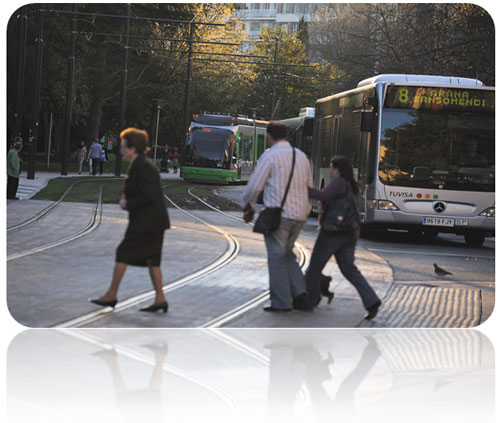 Whenever possible, walk or cycle to get around where you live. You will get fitter and also significantly help to cut greenhouse gases. In many places, you do not even need to own your own bike, as there are municipal bike loan or rental services.
If the distances are very long or you cannot travel by bike or on foot, use public transport, which is the most sustainable means of mobility for long journeys. And if you have to use your own vehicle due to time constraints or specific needs, consider car sharing. You will be saving money, you will help to cut down the number of cars in our towns and cities, and you will show your commitment to climate change.
Drive efficiently
When you have no other option than to use your own car, make sure you drive efficiently. These are the main points to be taken into account:
- If your car has a petrol engine, put it into gear immediately after starting it up. In the case of diesel engines, it is better to wait around three seconds before putting it into gear.
- Remember that you only use the first gear to get the car going and you should therefore change to second after two seconds or after travelling approximately six meters.
- The most efficient way of driving is to use high gears and low revs. That is the same in the city, but you should always respect speed limits.
- If your car has a petrol engine, accelerate and change gears when you reach 2000-2500 rpm. In the case of a diesel engine, when it is between 1500 and 2000 rpm.
- Save fuel by keeping your speed as constant possible and avoiding breaking and accelerating sharply and changing gears unnecessarily.
- Whenever speed and traffic conditions allow, it is better to stop the car without first changing down gears.
- You should turn off the engine during prolonged stops, i.e., over 60 seconds.
- You should always drive at a safe distance and with a good field of vision that lets you see 2 or 3 cars ahead of you. Apart from being safer, you will also be able to anticipate when you will need to brake and do so more gently.
- When driving at over 20 km/h with a gear engaged, fuel consumption is zero if you do not press on the accelerator. On the other hand, when idling, the car uses between 0.4 and 0.9 litres/km.
- Moderate your speed: apart from being fundamental to improve road safety, fuel consumption is much higher when driving at over 100 km/h.
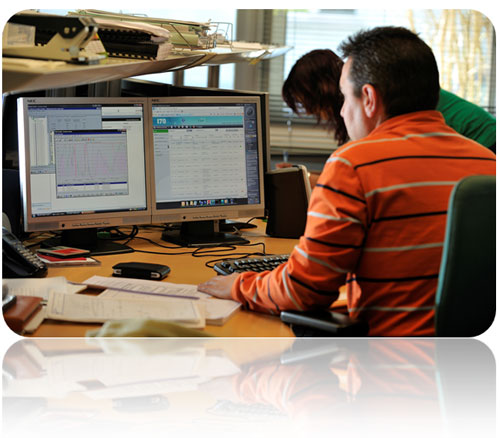
Going to work does not mean that have to stop being committed to the environment. At work, you can embrace new habits that will help to reduce the amount of waste generated, to save energy and to encourage the recycling of many materials that we regularly use.
Here is a series of tips to bear in mind when working with computers, printers, faxes and paper:
Computers
- Turn off when the computer when it is not going to be used for over an hour, such as during lunch breaks, long meetings or at the end of the working day.
- Buy computers or monitors with the ‘Energy Star’ log, which means that the computer, when configured correctly, saves energy when not being used.
- Try and opt for equipment with ‘bookmark’ shutdown, as this systems lets you, by entering the appropriate key sequence, switch off the equipment and record the last position at that time. This means that, when you switch the equipment on again, it will be in the same work position as the one you had left it when you switch it off.
- The only screen-saving mode that saves energy is the one that leaves the screen black, and you should therefore configure the screensaver in ‘Black Screen’ mode.
- Flat-screen monitors use less energy and emit less radiation.
- Laptop computers are more energy efficient that desktop ones.
- Equipment uses some energy even when switched off and you should therefore unplug the power supply at the end of the day.
Printers and faxes
- Activate “toner saving" when printing or photocopying, if you have that option.
- Always try to print in black and white whenever possible.
- Buy equipment with the “energy saving" mode (Energy Star, Powersave), which will mean that consumption is reduced to the minimum when not being used or on stand-by.
- Shake the toner cartridge when the toner running out alert begins to appear, as you can still use it for many copies more.
- Use recycled toner and/or ink cartridges.
- Place the used cartridges in a container to make it easier to collect them.
- Use an authorised manager to collect the used cartridges.
Paper
- Photocopy and print on both sides, as that reduces the amount of paper used by half.
- Print using the “2 pages per sheet” option.
- Work digitally: encourage the workforce to use email for external and internal communications. Internal communication computer networks (intranet) and email contribute to sending and receiving information without needing to use paper.
- Check texts in the PC, using the preview function or the spellcheck, before printing them to avoid printing documents with errors.
- Use recycled paper (bleached, without chlorine compounds and with 50% recycled fibre) both for internal use and for information or advertising leaflets. One of the printer trays can be used for this purpose.
- Separate the paper from the other rubbish and dispose of it in specific bins for used paper, located alongside the printer and then using the standard recycling collection channels.
- Do not use a fax cover sheet in order to save paper and transmission time.
- The blank sides of sheets of paper already printed on the other side can be used for faxes, to print a draft, etc.
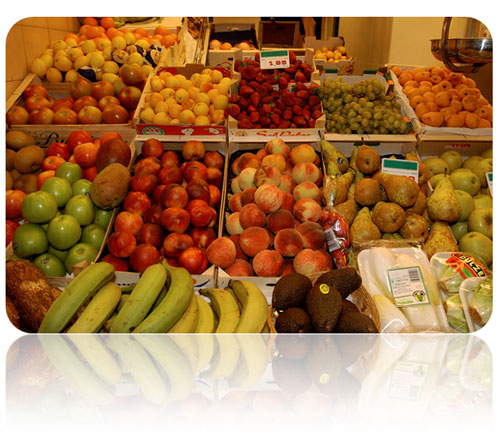 Shopping is one of the everyday activities when you can make your commitment to combating climate change clear. Responsible consumers are noted for taking into account aspects such as the packaging, whether or not the product is locally sourced, the traceability of the food or materials used to produce what we buy.
If you would also like to be a responsible consumer, just follow these tips:
- It is better to choose long-lasting materials over breakable items.
- If you choose seasonal and local products, you reduce the energy consumption needed to produce and transport them.
- When you shop locally, you prevent the emissions from your travelling to the store. If you have to travel to shop, it is better to use public transport or go by bike, as your emissions ratio per traveller is lower.
- Wherever possible, you should choose products with replacement parts, such as diaries, biros or razors.
- It is better to buy in bulk products such as fruit, vegetables, charcuterie, olives, pulses, fruit and nuts, biscuits, etc. When buying packaged products, choose the largest possible packages, which will reduce the amount of packaging in household rubbish.
- Use your own bags or a shopping cart.
- Avoid air fresheners that contain substances such as CFCs and paradichlorobenzene.
Last modified date: