Climate change. Key questions
 The Earth’s climate is permanently evolving. The change overtime is due to natural causes and due to people's production activities and consumption habits. There is now widespread consensus among the scientific community that the production model and energy consumption caused by human action has sped up climate change with serious consequences for the Earth. These changes to the climate occur in all the meteorological parameters: temperature, atmospheric pressure, rainfall, cloud cover, etc, as the 5th IPCC report concludes.
The United Nations Framework Convention on Climate Change (UNFCCC), endorsed by governments of 194 states, given the convincing evidence gathered by the Intergovernmental Panel on Climate Change (IPCC) to show that this phenomenon is occurring, defines it as "a change of climate which is attributed directly or indirectly to human activity that alters the composition of the global atmosphere and which is in additional to natural climate variability observed over comparable time periods”.
Human action has caused a global warming of the planet, which is having alarming effects and whose intensity is forecast to increase progressively in the future. The strong dependence of societies' current consumption and production model on fossil fuels (oil, gas, coal, etc.) has generated a volume of emissions that alters the balance of the planet.
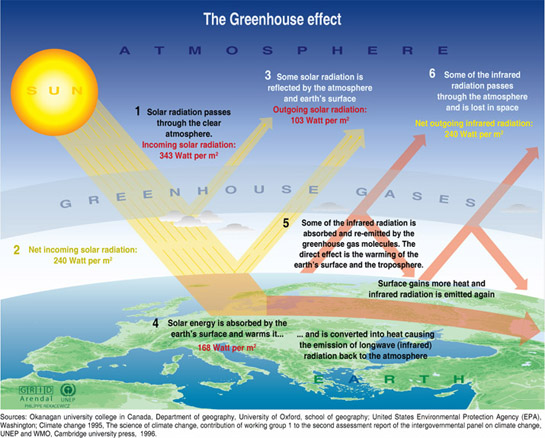
Infrared radiation from the sun is the main source of energy that our planet receives. Once it reaches the earth’s surface, it is redistributed by the oceanic currents and atmospheric flows and subsequently returned to space. The balance between the radiation received and returned ensures appropriate conditions for life. Increased greenhouse gas concentrations limit the irradiation of this energy into space, leading to greater heating of the lower atmosphere and the surface.
 There are numerous greenhouse gases, six of which have been regulated in international climate change regulations (Kyoto Protocol). Carbon dioxide (CO2) is the most abundant of them, even though methane (CH4) and nitrous oxide (N2O) play a very relevant role in less developed economies. Fluorinated gases (hydrofluorocarbons, sulphur hexafluoride and perflurocarbons) are associated to the new chemical industry and its emissions are concentrated at its consumption or production points. The second commitment period, commonly known as Post-Kyoto, also includes nitrogen trifluoride (NF3) in its regulations. Therefore, six gases have been traditionally regulated and a seventh has been added in the Post Kyoto period.
 Greenhouse gases have, in general, a very long residence time in the atmosphere, which means that their impact lasts for longer periods of time. Emissions are accumulated for a long time in the atmosphere and emissions therefore need to be dramatically reduced to avoid global warming exceeding 2 ºC.
Global emissions need to be reduced to below 1990 levels in a short time period and then continue to be decreased in order to achieve a stabilisation of CO2 concentration in the atmosphere.
 The growth of the economy in third-world countries will go hand-in-hand with higher atmospheric emissions, as has been the case in developed countries. Therefore, the stabilisation must affect different countries in different ways depending on their development level. Consequently, advanced countries must further reduce their emissions to ensure that they are not at the same level, they can develop and the total emissions be lowered to meet the internationally agreed target.
Last modified date: