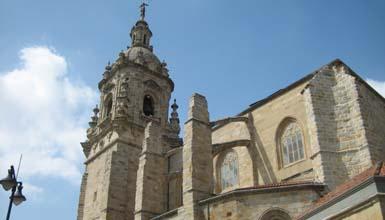
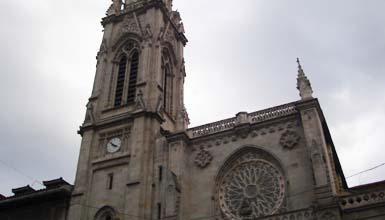
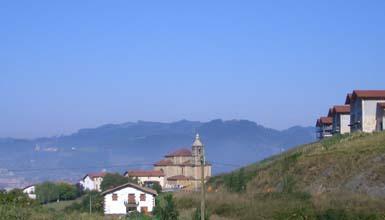
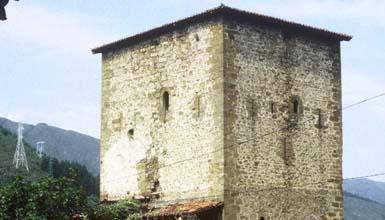
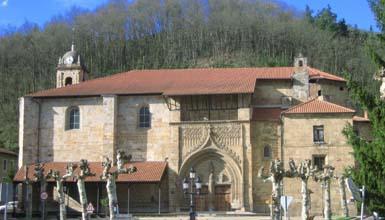
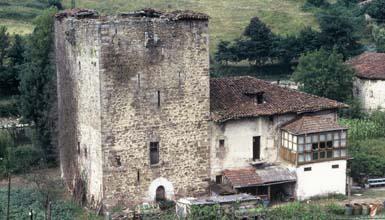
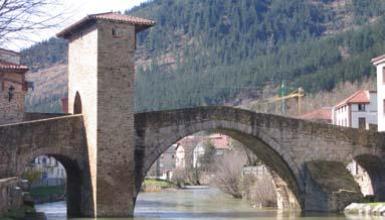
The route along the coast begins the seventh day of our journey in the very heart of the Basque country, Bilbao, a city which has become a landmark metropolitan city. One of the main entry points to the city was accessed by the Castillo bridge, presently the bridge of San Antón. The bridge and the church, gothic-style and quadrangular in shape, have come to be the symbol representative of the town as is displayed on the town's coat of arms. It's worth noting the elegant Santiago Cathedral, gothic-style and dedicated to Santiago, patron of the town. We should take the Basurto-Kastrexana road to continue on our itinerary. Once we have reached Kastrexana, we'll continue along the Bilbao-Balmaseda road, very near to the Devil's bridge (puente del Diablo) over the river Kadagua, natural border between the Biscayan capital and Barakaldo. The bridge will lead us to Alonsotegi, one of the most mountainous municipalities in Biscaya. A short distance after, we will discover the hermitage dedicated to Nuestra Señora de la Guía, whose chapel dates back to the year 1933. Our next landmark point is the town of La Quadra in the municipality of Güeñes, home to the striking and emblematic Salcedo tower, an ancient scene of faction fighting. This enclave, in turn, stands out for its magnificent church of Santa María. As we enter Zalla, leaving behind the town of Aranguren, we discover the pretty area of San Pedro de Zarikete, situated at the foot of the Medieval Road. Other enclaves of great historic and ethnographic interest are the 16th century hermitage of San Pedro Ad Vincula, the old house of la Beata, Gernika's sprouting oak tree, the main square with the pilgrims' fountain and la campa del Santo fields. We will continue towards Balmaseda parallel to the course of the Kadagua river. Before ending this stage of the walk, we will pass by the Terreros Tower, the Urrutia Palace and the hermitage of San Antonio de Padua, to enter Balmaseda through the neighbourhood of La Magdalena. Balmaseda is the first town in Biscaya; it has known how to preserve its rich historical and artistic heritage down through the centuries. Its two churches, San Severino and San Juan, stand out; nonetheless, it most representative structure is Muza Bridge, declared a National Monument. Following the old roman road we travel further into the Valley of Mena to continue walking along the lands of Burgos towards Santiago de Compostela.