The home-field factor: Lasa and Nazabal win Basque stages
author: Ander Izagirre,
Miguel Mari Lasa was not the best climber or the best sprinter. But he was very good at those disciplines and had a subtle advantage: his intelligence in the race, his obsessive study of the stages and his rivals. That's why he won so many times.
That's why he won the ninth stage of the 1978 Tour, because he knew the final very well.
- It was ending in the same place as a stage of the Tour of the Basque Country that same year: "at the Biarritz racecourse", recalls Lasa. The track was made of ash. In April, at the Tour of the Basque Country, I noticed that the wheel was sinking a bit, that the road surface was heavier than the asphalt, and in July, at the Tour, I took that into account.
By then Lasa was a veteran cyclist who had already won stages in the Vuelta, the Giro and the Tour. And he knew his rivals inside out.
- He had his eye on Jan Raas.
The Dutchman, one of the best classics riders of the time, had won the prologue and the first stage of that 1978 Tour.
- Raas was crazy to win another stage, I saw that in the previous days he had taken part in all the sprints and he was running out of chances because the Pyrenees were just around the corner. I thought that in Biarritz he would go for it. I decided to start the sprint right behind him, because I imagined what could happen on the cinder track. It wasn't easy to get on his wheel, wasn't it? There were a lot of riders fighting for it.
Lasa was always adept at jockeying for position. He remembers his first Giro, at the age of 22, when his veteran team-mates in the La Casera team preferred to stay out of trouble in the sprint: the Italians and Belgians would throw elbows and get into fights ("eh, spagnolo, spagnolo!"), but Lasa had no complexes about sticking his handlebars in.
- I thought: since we've come all this way, against all these champions, we'll have to have a bit of a laugh, won't we?
In one of those rides, he won the first of his four stages in the Giro ahead of Huysmans, Godefroot, Merckx, Van den Bossche, Zilioli, Zandegú and Gimondi: a tremendous cast of gladiators.
- I couldn't believe it. All those figures there, and here I am, a baserritarra from Oiartzun, and I beat them... What madness!
At the finish of the Tour of Biarritz in 1978, Lasa was not intimidated either: the sprinters and their pacers unleashed a fierce fight to enter the racecourse in the first positions, Gerben Karstens tried to get between two cyclists who were blocking his way, crashed his handlebars against a thigh, flew off and knocked Freddy Maertens off his feet. Two favourites eliminated. Lasa dodged the fall and kept his dream position: on the wheel of Raas.
- In the last corner, Raas went off with all the development. Just what I was hoping for. The straight was very long, the tyres were sinking into the ash, and when I saw that Raas was struggling to maintain his cadence, I started to overtake him with a lighter development.
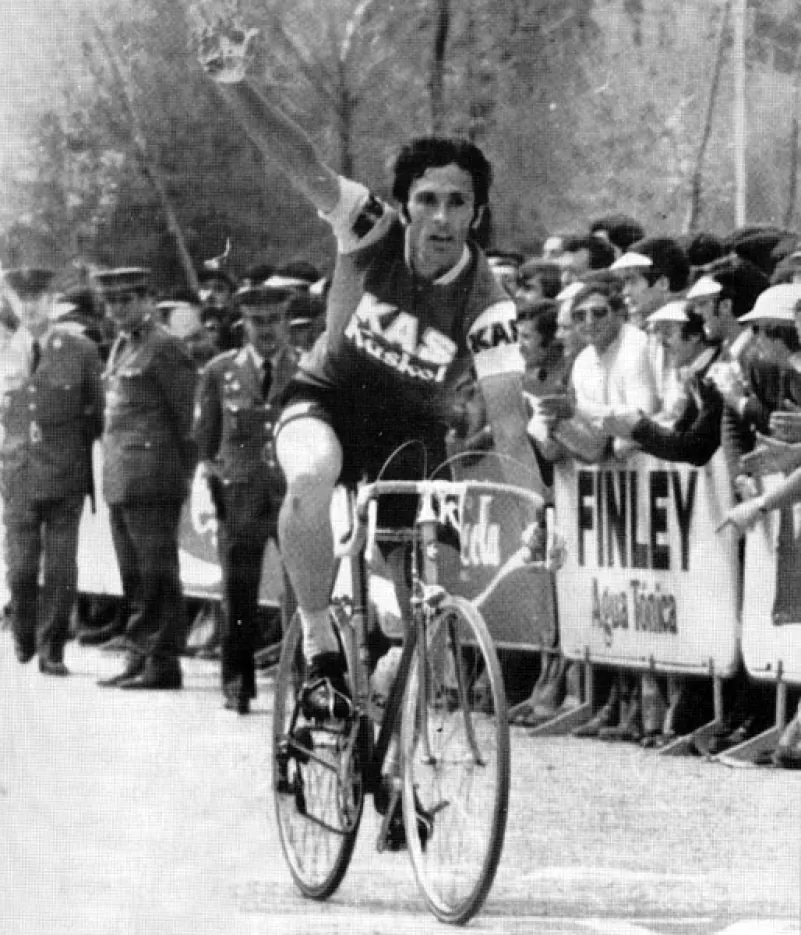
Lasa stepped on the line, raising his right hand with a gesture of euphoria.
- Raas was beating me nine sprints out of ten. And if the Biarritz final had been on asphalt, he would have beaten me too. But I knew about the ash finish, I chose the right development and he didn't. In the following days, Raas would come to me and say: "Lasa, you bastard! -he laughs. That's what happened to me: I always had cyclists in front of me stronger than me. Some of them just had to push hard on the pedals to win, but I had to study some way to beat them.
Lasa had already won the Tour two years earlier, in a Belgian stage that followed the undulating route of the Flèche Wallonne, with a festival of attacks and counter-attacks. On that occasion, he came across the finish line with Guy Sibille, the French champion, and beat him in the sprint. Another triumph of brilliance. But the one in Biarritz was special: he celebrated the victory acclaimed by the Basque public, forty kilometres from his home in Oiartzun, and in the hotel he met his wife and his two-year-old son.
- Winning a Tour stage at home is one of the best memories of my career," he says.
CELEBRATION WITH KAS
The third stage of the 1977 Tour didn't just go home, it went right into the kitchen, right into the fridge: it finished on Avenida de los Olmos in Vitoria-Gasteiz, next to the Kas soft drinks bottling plant.
The boss Luis Knörr, a cycling passionate, had insisted on having this stage finish in his factory and the Tour organised it as a tribute to the most emblematic Basque team of the 20th century. That morning, at the start in Oloron, the Kas riders received a clear order: they had to get into all the breakaways to win the stage by any means necessary.
In the first few kilometres, they had to contain their eagerness. The director of the tour ordered the race to be stopped because a bomb had exploded on the border pass of Izpegi in the path of the publicity caravan and rocks had broken off, injuring a child and cutting the road. The cyclists waited for three quarters of an hour until the area was cleared and guarded by the gendarmerie, and the race resumed.
The riders aiming for the mountains prize fought it out in Izpegi, Lucien Van Impe (winner of the previous Tour) went first and the peloton came together on the descent to the Baztan valley.
- After Elizondo the war began, there were many attacks and in one of them I went with the Italian Rossi and a Belgian -recalls José Nazabal, from the Kas team-. On the climb to the Ezkurra hill, they dropped off and I rode alone.
There were more than a hundred kilometres to go to Vitoria. Behind, the counter-attacks cancelled each other out, the peloton took a break and Nazabal reached a lead of ten minutes.
- It was very difficult to maintain a solo breakaway on all those plains of Navarre and Alava, but when they accelerated to get me, it was already too late.
Nazabal was riding very strongly. That same year he had won a stage of the Vuelta a España with a final on the Urkiola climb, as well as the Vuelta a Aragón and the Vuelta a los Valles Mineros, and a few weeks before the Tour he had finished sixth in a Dauphiné dominated by Hinault, Thévenet, Van Impe, Zoetemelk and Merckx (almost nothing: fourteen Tours won between the five of them). The year before, he had finished third in the Vuelta a España.
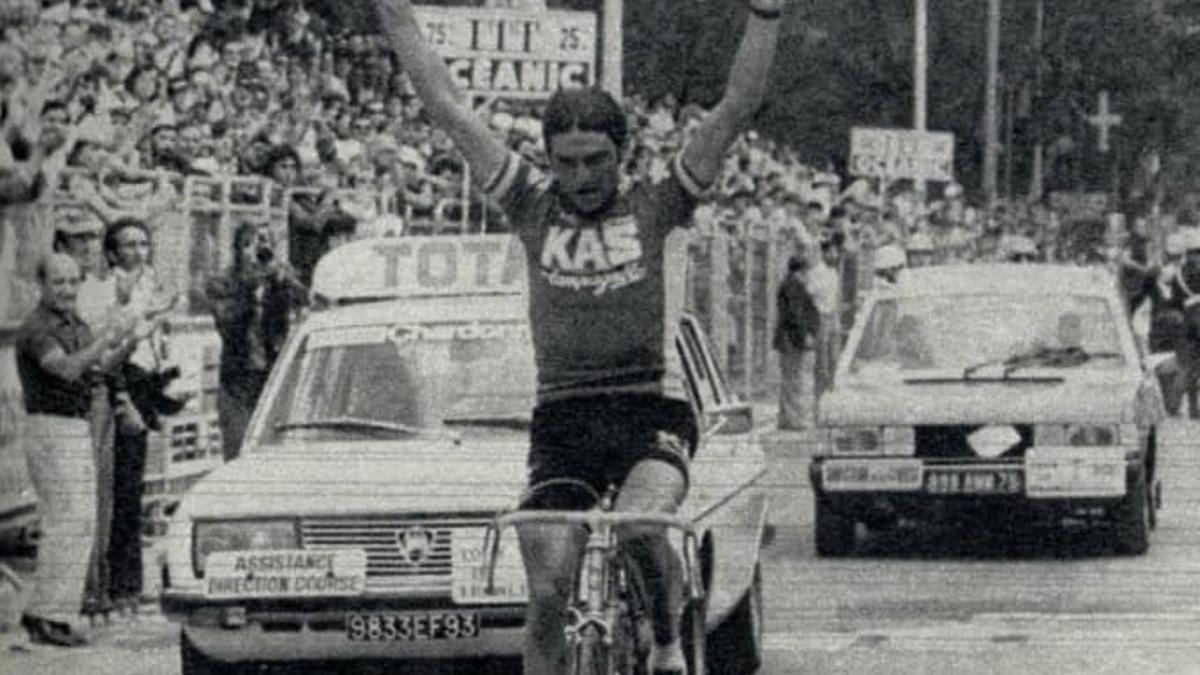
- I was just an ordinary cyclist, I didn't win much, I was there to help others. But in the Vitoria stage I was lucky enough to catch the breakaway, to leave my teammates behind and everything went well, says the rider from Zaldibia, as if anyone could sustain a hundred-kilometre pulse on the peloton in an entire Tour de France. They cut five minutes off him, he had enough minutes left over to raise his arms and he entered with the triumphant Kas jersey at the same factory from which the team had left.
Miguel Induráin from Navarre won the 1992 prologue in San Sebastián; two days later, Javier Murguialday from Alava won the stage from the capital of Gipuzkoa to Pau; Roberto Laiseka from Bizkaia and Samuel Sánchez from Asturias won in the Euskaltel jersey in Luz Ardiden in 2001 and 2011 when the orange tide turned the Pyrenees into an extension of the Basque Country. The 2023 Tour will once again offer Basque cyclists the advantage of knowing the terrain and racing with an effervescent motivation: the advantage of competing at home.
Author: Ander Izagirre