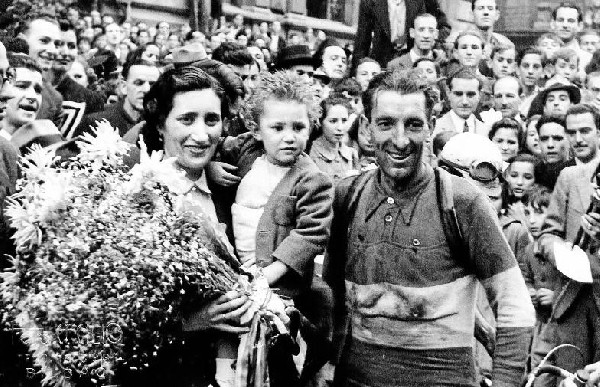
TRIUMPH AND EXILE FOR FEDERICO EZQUERRA
author: Ander Izagirre,
When Federico Ezquerra set off with all his might on the col de la Turbie, he was launching the breakaway of his life. Firstly, for a foreseeable reason: if he reached the top of the mountain with a slight lead, his pursuers would no longer be able to catch him on the short descent to Nice and he would become the first Basque to win a stage of the Tour de France. Secondly, for an unexpected reason: it was July 19, 1936; the day before, the military had staged a coup against the Spanish Republic, a civil war was breaking out and Ezquerra, a Biscayan born in Gordexola, a neighbouring village of Sodupe, would take a long time to return back home. The cycling getaway lasted about thirty kilometres. The life-saving one, a year and a half.
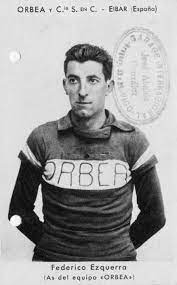
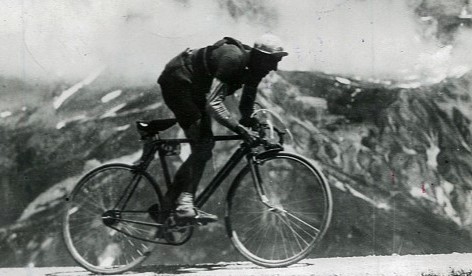
Ezquerra was fed up. He was one of those explosive climbers like the Cantabrian Vicente Trueba, the Madrid-born, Julián Berrendero, or the Navarrese-Catalan Mariano Cañardo, who would drop the favourites in the mountains and then go down without a prize, because in those days there were no summit finishes, and the chasers would organise themselves to hunt them down on the long downhill and flat sections to the finish line in the cities. This happened time and again to Ezquerra. In the 1934 Tour, he got a puncture just before the start of the climb to the Galibier, overtook all the riders one by one, caught the French idol René Vietto yet in the snows, punched his way through the spectators who were pushing Vietto and blocking his way, topped the Galibier with a record time of 1h 58 minutes 30seconds, won a bonus of fifteen thousand francs and on the endless descent to Grenoble was caught by five riders. He finished fourth. "That day I understood that to win a stage of the Tour you had to be a sprinter and have a team of percheron at your disposal", declared Ezquerra. "According to me, neither one nor the other".
In 1936, he lost the third stage in the same way: he rode through the Ballon d'Alsace, the leader Maurice Archambaud caught him at the entrance to the Belfort velodrome and beat him in the final sprint. So on the eleventh stage, on the col de la Turbie, Ezquerra faced with the opportunity of a lifetime, the opportunity to climb: he was in the breakaway with the Flemish riders Maes and Vervaecke (who would finish first and third in that Tour), he attacked them from the base, topped out at 1m 50s and maintained the gap on the short descent to Nice.
In the Basque Country, Ezquerra's triumph sounded remote and muffled amidst the drums of war.
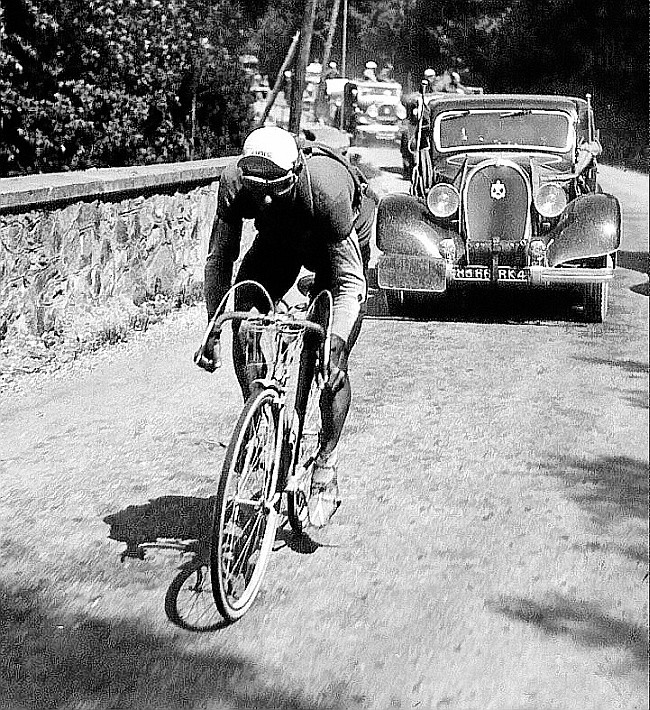
When the Tour ended, Ezquerra and Berrendero remained in France. They settled in Pau and earned their living competing in French teams. Some Spanish newspapers published criticisms of the sportsmen who had gone into exile instead of reporting for duty, although the Republican government was happy to see these celebrities defending its cause abroad. 'El Mundo Deportivo' gave them a shout-out: "Spanish football stars, cycling aces and pugilists of some renown invade Gaul to escape the hardships of the war that overshadows the sunny lands of Spain, that gave them so many honours and benefits. Thus, they find a way to live without anguish and deprivation. Let them continue to run, but let them not neglect their duties to the Republic".
The next Tour, in 1937, was won by a cyclist born in the Basque Country: Roger Lapébie, the son of a train driver stationed in Baiona. Due to another job change, the family moved to the suburbs of Bordeaux when Roger was six years old and lived there from then on.
That year, the Spanish selected riders for the Tour signed a manifesto of support for the Republic and announced that they would donate half of their winnings to war orphans. Cañardo and Berrendero achieved two very emotional victories in the Pyrenees, acclaimed by the refugees who had fled to France, even by the Republican soldiers who crossed the international bridge at Puigcerdà to see the start of the second sector of the stage at Bourg-Madame. There, Cañardo met his brother-in-law, who had been missing for months, embraced him, took the start, passed first over the col de Puymorens and won at Ax-les-Thermes.
The triumph of Cañardo, a native of Olite, coincided with Federico Ezquerra's last rides in the Tour. The Biscayan retired that same day, ill, feverish, dressed for the last time in the Republican tricolour jersey (purple, red, yellow), because at the end of the season he returned back to the Basque Country; the new Francoist authorities closed down and he never competed again in France.
Author: Ander Izagirre  , journalist and writer.